Context for rendering into a WebGL stream. More...
#include <ocean/Argyroneta/WebGL/WebGLRenderContext.hpp>
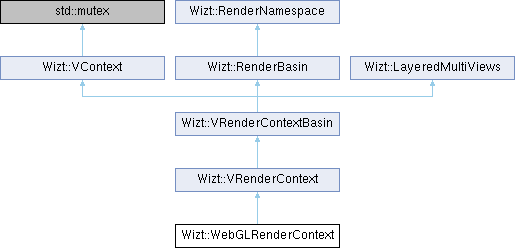
Public Member Functions | |
| MemCore::RefPtr< RenderParameter > | createRenderParameter (const std::string &, const void *data, const std::type_info &type, int Multiplicity) override |
| Create a generic rendering parameter. | |
| MemCore::RefPtr< VertexAttribute > | createVertexAttribute (const MemCore::RefPtr< MemCore::ChunkBase > &Data, const std::string &name) override |
| MemCore::RefPtr< Painter > | drawPrimitives (Primitive, size_t howmany=0) override |
| MemCore::RefPtr< RenderFlag > | Enable (const char *what, bool Yes=true) override |
| Virtual OpenGL call to enable some rendering flag. | |
| int | render (const ObjectSelection &RenderObjects, double &RenderTime, int MinLevel=RENDER_FIRST, int MaxLevel=RENDER_LAST) override |
| Implementation of object layer traversal, setting OpenGL matrizes for each RenderCategory. | |
| Geometry | viewport () const override |
| Return the viewport properties of the render context, as set by glViewport();. | |
| WebGLRenderContext (std::ostream &WebStream, const RefPtr< VRenderPrecision > &Hints) | |
| Constructor. | |
| virtual | ~WebGLRenderContext () |
| Constructor. | |
| Public Member Functions inherited from Wizt::VRenderContext | |
| bool | allowRendering (Anemone &RenderAnemone) |
| Check if the given Anemone fits into the AvailableGPURAM, and if so, subtract its memsize() from it and return true. | |
| virtual MemCore::RefPtr< Anemone::Tentacle > | createFontTentacle (const string &text, const VTextRenderProperties &VTRP, const RefPtr< Font > &theFont) const |
| Create a Tentacle to render text. | |
| template<class Type> | |
| MemCore::RefPtr< RenderParameter > | createRenderSlot (const std::string &what, const TypedSlot< Type > &InputSlot) |
| Create a cached render parameter with an explicit name from an VObject's input using the current value of this slot. | |
| template<class Type, class Modifier> | |
| MemCore::RefPtr< RenderParameter > | createRenderSlot (const std::string &what, const TypedSlot< Type > &InputSlot, const Modifier &M) |
| Couple a TypedSlot with a uniform variable of some Shader. | |
| template<class Type> | |
| MemCore::RefPtr< RenderParameter > | createRenderSlot (const std::string &what, const TypedSlot< Type > &InputSlot, const Type &DefaultValue) |
| Create a cached render parameter with an explicit name from an VObject's input and given default value. | |
| template<class Type> | |
| RPtr | createRenderSlot (const std::string &what, const TypedSlot< Type > &InputSlot, const Type &DefaultValue, const WeakPtr< ValuePool > &Context) |
| Create a render parameter that will be connected to a given TypedSlot such that a dependency is considered and Anemone::updateValues() handles this input slot. | |
| template<class Type> | |
| MemCore::RefPtr< RenderParameter > | createRenderSlot (const std::string &what, const VObject::in< Type > &InputSlot) |
| Create a cached render parameter with an explicit name from an VObject's input. | |
| template<class Type> | |
| MemCore::RefPtr< RenderParameter > | createRenderSlot (const TypedSlot< Type > &InputSlot) |
| Create a cached render parameter from an VObject's typed slot which will be named identical to the object's slot, using its current value. | |
| template<class Type> | |
| MemCore::RefPtr< RenderParameter > | createRenderSlot (const VObject::in< Type > &InputSlot) |
| Create a cached render parameter from an VObject's input slot which will be named identical to the object's input. | |
| double | getAspectRatio () const |
| Width / Height of the current output device, i.e. | |
| const VCamera & | getCameraSettings (unsigned Eye, unsigned int ViewportIndex=0) const |
| Properties of the camera. | |
| virtual RefPtr< Font > | getFont (const std::list< string > &fontnames={}, Font::Type=Font::Type(), Font::RenderHint=Font::RenderHint::Extruded, const RefPtr< VCreationPreferences > &prefs=nullptr) |
| Get a font object. | |
| const Eagle::PhysicalSpace::Frustum & | getFrustum (unsigned Eye, unsigned int ViewportIndex=0) const |
| The view frustum related to the current CameraSettings. | |
| double | getViewportAspectRatio (unsigned int ViewportIndex=0) const |
| Return the aspect ratio of the current viewer window, i.e. width / height. Returns 1.0 if no output medium is defined. | |
| virtual bool | isCancelled () |
| Virtual callback function that tells if this render context is supposed to be cancelled (stopped). | |
| int | isVisible (const Eagle::BoundingBox &DataBBox, unsigned Eye=0) const |
| View Frustum Culling; test if AA-BoundingBox is visible. | |
| virtual bool | notifyError (const RenderAble &ErrorObject, const RenderException &theError) |
| Optional function for logging errors. | |
| virtual void | openEye (unsigned EyeNumber) |
| The frustum parameters are set into the View structure as provided in. | |
| virtual RefPtr< PickList > | pick (const ObjectSelection &theRenderObjects, int X, int Y, int DX, int DY, int MinLevel=CAMERA_OBJECT-1, int MaxLevel=RENDER_LAST)=0 |
| Feedback buffer rendering, considering the objects given in the provided selection. | |
| RefPtr< PickList > | pick (const ViewportGeometry &PickArea, const ObjectSelection &theRenderObjects, int MinLevel=CAMERA_OBJECT-1, int MaxLevel=RENDER_LAST) |
| Return a touch list covering the given pick area, using the specified render objects. | |
| RefPtr< PickList > | pick (const ViewportGeometry &PickArea, int MinLevel=CAMERA_OBJECT-1, int MaxLevel=RENDER_LAST) |
| Return a touch list covering the given pick area, using the internally stored objects. | |
| RefPtr< PickList > | pick (int X, int Y, int DX, int DY, int MinLevel=CAMERA_OBJECT-1, int MaxLevel=RENDER_LAST) |
| Pick objects in the current area, as they are specified in the internal myRenderObjects list. | |
| RenderResult | render (double &RenderTime, int MinLevel=RENDER_FIRST, int MaxLevel=RENDER_LAST) |
| Render all objects as specified in ObjectSelection RenderObjects. | |
| virtual RenderResult | render (ObjectSelection &theRenderObjects, double &RenderTime, int MinLevel=RENDER_FIRST, int MaxLevel=RENDER_LAST)=0 |
| Implementation-specific function to traverse all objects that ought to be rendered. | |
| void | setLightSources (const ObjectSelection &theRenderObjects) const |
| Update the light sources that reside at the seagrass cache which is associated with this render context as permanent storage item. | |
| virtual ViewportGeometry | viewport (unsigned int ViewportIndex=0) const =0 |
| Return the viewport properties of the render context, as set by glViewport();. | |
| VRenderContext (const SeagrassWeakPtr_t &theSeagrass, const WeakPtr< Interruptor > &theInterruptor, const RefPtr< VRenderPrecision > &Hints, unsigned NumberOfEyes, int64_t AvailableGPURAM) | |
| Constructor, provide render hints. | |
| virtual | ~VRenderContext () |
| Constructor. | |
| void | setProjectionFrustum (const Eagle::PhysicalSpace::Viewport &CameraRelativeFrustum, double zNear, double zFar, bool Orthographic, unsigned Eye, const Jitter &jittering, unsigned int ViewportIndex=0) |
| Load the OpenGL projection matrix. | |
| void | setTileAwareFrustum (double FrameScaleFactor, const Eagle::PhysicalSpace::Viewport &CameraRelativeFrustum, double Near, double Far, bool Orthographic, unsigned Eye, const Jitter &jittering, unsigned int ViewportIndex=0) |
| Consider PixelZoom and Tile parameters to compute a local viewport from the Frame and FrameScaleFactor, then call setProjectionFrustum(). | |
| void | setTileAwarePerspective (double fovy, double Near, double Far, bool Orthographic, unsigned Eye, const Jitter &jittering, unsigned int ViewportIndex=0) |
| Set the projection in the current view. | |
| void | setEyeView (const VCamera &theCameraSettings, double Near, double Far, bool Orthographic, unsigned EyeNumber, double ZeroParallaxDistance, double EyeSeparation, unsigned int ViewportIndex=0, bool ToeIn=false) |
| Given a camera (note that it will be modified during this call if the camera settings are a reference to getCameraSettings(0) ) and stereo vision parameters, set a modified camera and a shifted, asymmetric frustum suitable for stereo rendering. | |
| void | setPerspective (double Near, double Far, bool Orthographic) |
| Simplified version of setTileAwarePerspective(), very similar to gluPerspective() . | |
| void | setPerspective (double fovy, double Near, double Far, bool Orthographic) |
| Simplified version of setTileAwarePerspective(), very similar to gluPerspective() . | |
| void | setTileAwareIdentity (unsigned Eye, double Near=0.0, double Far=2.0, const Jitter &jittering=defaultJitter(), unsigned int ViewportIndex=0) |
| Set projection such that the viewport maps to [-1,-1]x[1,1]. | |
| Public Member Functions inherited from Wizt::VRenderContextBasin | |
| void | queue (const ComputationFunctor &CF) const |
| Schedule a computational functor for execution in a separate thread which has access to the same opengl ID resources. | |
| Public Member Functions inherited from Wizt::VContext | |
| operator const RefPtr< ValuePool > & () const | |
| A VContext may be implicitely converted into a reference pointer to a ValuePool. | |
| template<typename... SlotList> | |
| auto | operator() (SlotList... t) const -> decltype(evaluateSlots(GhostValues, t...)) |
| Evaluate a set of input slots at once, return the values as a std::tuple<> according to the slot values. | |
| string | PoolName () const |
| Return the name of the associated value pool. | |
| void | setTime () |
| set the time according to the current system time | |
| VContext (const RefPtr< Addendum > &CAddendum=NullPtr()) | |
| Constructor. | |
| VContext (const RefPtr< ValuePool > &myValuePool, const RefPtr< Addendum > &CAddendum=NullPtr()) | |
| Constructor with ValuePool. | |
| VContext (const RefPtr< ValuePoolProvider > &myValuePoolProvider) | |
| Context constructor, taking optional parameter ValuePoolProvider to setup the GhostValues in this context. | |
| virtual | ~VContext () |
| Destructor. | |
| Public Member Functions inherited from Wizt::RenderBasin | |
| RefPtr< StorageBufferTentacle > | bindStorageBuffer (Anemone &A, const char *BufferName, const void *theStorageData, size_t N, Buffer::StorageFlags={}) const |
| Create a storage buffer from the given data and bind it to all shader programs that are found at the given Anemone under the same buffer name. | |
| MemCore::RefPtr< VertexAttribute > | createCoordinates (const MemCore::RefPtr< MemCore::ChunkBase > &VertexData) |
| Convenience function to load coordinates as vertex attribute. | |
| MemCore::RefPtr< Program > | createGeometryProgram (const ShaderProgram &VertexShader, GeometryInputType geom_in, const ShaderProgram &GeometryShader, GeometryOutputType geom_out, const ShaderProgram &FragmentShader, const RenderBasin::Program::Setup &SetupFunction=nullptr, const MemCore::RefPtr< RenderBasin::Program > &ExistingProgram=nullptr) |
| Create a shader program using a geometry shader. | |
| MemCore::RefPtr< Program > | createGeometryProgram (const std::string &VertexShader, GeometryInputType, const std::string &GeometryShader, GeometryOutputType, const std::string &FragmentShader, const std::string &VertexShaderURL, const std::string &GeometryShaderURL, const std::string &FragmentShaderURL, const RenderBasin::Program::Setup &SetupFunction=nullptr, const MemCore::RefPtr< RenderBasin::Program > &ExistingProgram=nullptr) |
| Create a shader program using a geometry shader. | |
| virtual MemCore::RefPtr< Program > | createGeometryProgram (const std::vector< std::string > &VertexShader, const std::string &VertexShaderURL, unsigned VertexShaderLineNumber, GeometryInputType, const std::vector< std::string > &GeometryShader, GeometryOutputType, const std::string &GeometryShaderURL, unsigned GeometryShaderLineNumber, const std::vector< std::string > &FragmentShader, const std::string &FragmentShaderURL, unsigned FragmentShaderLineNumber, const RenderBasin::Program::Setup &SetupFunction=nullptr, const MemCore::RefPtr< RenderBasin::Program > &ExistingProgram=nullptr)=0 |
| Virtual function to create a shader program, possibly using a geometry shader. | |
| virtual MemCore::RefPtr< ElementAttribute > | createIndexBuffer (const MemCore::RefPtr< MemCore::ChunkBase > &ElementData)=0 |
| Create an index buffer containing the element indices. | |
| MemCore::RefPtr< Program > | createProgram (const glsl &VertexShader, const glsl &FragmentShader, const std::string &VertexShaderURL, const std::string &FragmentShaderURL, unsigned VertexShaderLineNumber=0, unsigned FragmentShaderLineNumber=0, const RenderBasin::Program::Setup &SetupFunction=nullptr, const MemCore::RefPtr< RenderBasin::Program > &ExistingProgram=nullptr) |
| Create a shader program from GLGS source code constructed from a vertex and fragment shader. | |
| MemCore::RefPtr< Program > | createProgram (const ShaderProgram &VertexShader, const ShaderProgram &FragmentShader, const RenderBasin::Program::Setup &SetupFunction=nullptr, const MemCore::RefPtr< RenderBasin::Program > &ExistingProgram=nullptr) |
| Create a program from vertex and fragment shader. | |
| template<class Lambda> | |
| RPtr | createRenderLambda (const std::string &what, VRenderContext &Context, const Lambda &theLambda) |
| template<class Type> | |
| RPtr | createRenderParameter (const std::string &what, const Type &Data) |
| Set variable of a given type, making use of the available META::MetaInfo<> type trait template. | |
| template<class SlotType, class ShaderType> | |
| RPtr | createRenderParameterWithStdFunctor (const glsl &what, const TypedSlot< SlotType > &InputSlot, const SlotType &SlotDefaultValue, const ShaderType &ShaderDefaultValue, const std::function< ShaderType(const VRenderContext &Context, const SlotType &SlotValue)> &theFunctor) |
| A more or less internal helper function that takes a std::function object for coupling a TypedSlot to a shader parameter, intended to be used by createRenderSlotWithFunctor() with a lambda function. | |
| template<class Type> | |
| RPtr | createRenderSlot (const std::string &what, const TypedSlot< Type > &InputSlot, const Type &DefaultValue, const WeakPtr< ValuePool > &Context) |
| Create a render parameter that will be connected to a given TypedSlot such that a dependency is considered and Anemone::updateValues() handles this input slot. | |
| template<typename F> | |
| auto | createRenderSlotWithFunctor (const glsl &what, const TypedSlot< typename render_lambda_signature< F >::slot_type > &InputSlot, F &&theFunctor) |
| Couple a VObject's input slot to a render parameter, in particular uniform shader variables, according to createRenderParameter(); Synopsis: | |
| MemCore::RefPtr< VertexAttribute > | createStdVertexAttribute (const MemCore::RefPtr< MemCore::ChunkBase > &VertexData, VertexAttributeTypes Type) |
| Convenience function to load coordinates as vertex attribute that is known as fixed standard attribute in older OpenGL (discouraged, modern OpenGL and shader code should use entirely user-defined names). | |
| virtual RefPtr< StorageBufferTentacle > | createStorageBuffer (const void *theStorageData, size_t N, Buffer::StorageFlags={}) const =0 |
| Create a storage buffer tentacle, which is a reference to an OpenGL storage buffer. | |
| virtual RefPtr< RenderBasin::StorageBufferTentacle > | createStorageBuffer (Intercube &DataCreator, const DataCreationFunction &f, const RenderBasin::Buffer::StorageFlags Flags={}) const =0 |
| Create storage buffer of the given size with initialization from the given data creator if there is no data storage buffer associated with the specified Intercube. | |
| virtual RefPtr< RenderBasin::StorageBufferTentacle > | createStorageBuffer (Intercube &DataCreator, size_t N, const RenderBasin::Buffer::StorageFlags Flags={}) const =0 |
| Create storage buffer of the given size without initialization, but reuse an existing storage buffer if such is given at the specified Intercube. | |
| virtual MemCore::RefPtr< TextureTentacle > | createTexture (const MemCore::RefPtr< MemCore::ChunkBase > &TextureData, TextureFormat TF, int rank, const size_t *Dimensions, int TextureUnit=0, TextureStorageFormat TSF=AutomaticTexture(), int level=0, bool GenerateDoMipMap=false, const MemCore::RefPtr< TextureTentacle > &OldTT=nullptr)=0 |
| Application call to the Render Context to create a Texture. | |
| virtual MemCore::RefPtr< Attribute > | createTextureBuffer (const MemCore::RefPtr< MemCore::ChunkBase > &TextureData, int textureUnit=0, bool doNormalize=false, int AttributeClass=0, int MaxBitStorage=0)=0 |
| Create a texture buffer, which are basically 1D arrays of data that can be accessed randomly in OpenGL. | |
| MemCore::RefPtr< VertexAttribute > | createTextureCoordinates (const MemCore::RefPtr< MemCore::ChunkBase > &TextureCoordData, int TextureUnit=0) |
| Convenience function to load texture coordinates as vertex attribute. | |
| MemCore::RefPtr< RenderFlag > | Disable (const char *what) |
| Disable some rendering flag. | |
| RefPtr< Illumination > | getIllumination () const |
| Insert into newly created Anemone objects, for instance via feedAnemone(). | |
| WeakPtr< Interactor > | getInteractor () const |
| Get the current Interactor . | |
| glsl | getLightSourceCode () |
| See getIllumination() for details. | |
| int | getNumberOfActiveLightSources () const |
| Get the number of currently active light sources. | |
| Seagrass & | getSeagrass () const |
| Get the Seagrass caching manager that is associated with this RenderBasin. | |
| const SeagrassWeakPtr_t & | getSeagrassPtr () const |
| Get a pointer to the Seagrass caching manager that is associated with this RenderBasin. | |
| virtual std::string | getShaderPlatformDefines () const =0 |
| Create a preprocessor string containing some platform-specific definitions. | |
| bool | lightingHasChanged (const AnemoneCreatorBase &A) const |
| Check whether the lighting managed by this RenderBasin (via its Seagrass) has changed so significantly such that shaders have to be recompiled. | |
| RefPtr< Interactor > | makeInteractor () const |
| Receive the current Interactor, if one is set already, and create a new one if that is not the case. | |
| void | mergeIlluminationUniforms (Program &P) const |
| For explicit handling of shader programs merge all the uniforms defined by the current set of light sources into the given Program. | |
| static TextureStorageFormat | MultichannelTexture (int nChannels, int Bits, bool Integer=false, bool Signed=false, bool Normalized=true, bool Compressed=true) |
| static TextureStorageFormat | MultichannelTexture (int nChannels, TextureStorageFormat::BitPrecision theBits=TextureStorageFormat::Unspecified, bool Integer=false, bool Signed=false, bool Normalized=true, bool Compressed=true) |
| Create some texture matching the number of specified channels, it will be: | |
| static TextureStorageFormat | OpenGLTexture (int OpenGLTextureTypeEnum, int BitsPerTexel, bool isInteger) |
| Create a texture storage format from an OpenGL texture enum, need to specify also the number of bits per texel for purposes of opengl memory management. | |
| static TextureStorageFormat | RedGreen (TextureStorageFormat::BitPrecision theBits=TextureStorageFormat::Unspecified) |
| color channels (two) | |
| RenderBasin (const SeagrassWeakPtr_t &mySeagrass) | |
| Construct a render basin with a weak pointer to a seagrass, which is a persistent manager for handling resources related to the respective rendering implementation. | |
| static TextureStorageFormat | Rgb (TextureStorageFormat::BitPrecision theBits=TextureStorageFormat::Unspecified) |
| color channels (three channels) | |
| static TextureStorageFormat | RgbAlpha (TextureStorageFormat::BitPrecision theColorBits=TextureStorageFormat::Unspecified, TextureStorageFormat::BitPrecision theAlphaBits=TextureStorageFormat::Unspecified) |
| color and alpha (four) | |
| void | setInteractor (const WeakPtr< Interactor > &) |
| Overwrite the current Interactor. | |
| Public Member Functions inherited from Wizt::LayeredMultiViews | |
| View & | CurrentView (unsigned Eye, unsigned int ViewportIndex=0) |
| Access the view of the current eye for the current projection layer such that it can be modified. | |
| const View & | CurrentView (unsigned Eye, unsigned int ViewportIndex=0) const |
| Access the view of the current eye for the current projection layer. | |
| const View & | getWorldView (unsigned Eye, unsigned int ViewportIndex=0) const |
| Access to the world view parameters, which are valid after the camera objects have been rendered. | |
| bool | isValid (const Anemone &) const |
| Check whether the Anemone is non-empty and the number of views in the Anemone matches the current settings. | |
| glsl | MultiViewPrefix (bool Define_num_views_layout=true, std::size_t MultiViewBindingPoint=0) const |
| Define in GSL. | |
| void | setNumberOfEyes (unsigned NumberOfEyes) |
| Change the number of views that are available for rendering. | |
Public Attributes | |
| std::string | CurrentProgram |
| The currently used shader program. | |
| Public Attributes inherited from Wizt::VRenderContext | |
| bool | CheckShaderSourceUpdates = true |
| A flag to indicate whether additional checks should be done for shader code updated on disk. | |
| MemCore::Timer | ContextRenderTimer |
| Measuring the Render Time since start. | |
| RefPtr< VRenderPrecision > | Hints |
| Additional information on how rendering should happen. | |
| Size | Image |
| For tiled rendering: Setup the Image size (in pixels) the size of one Tile (in pixels) and define the CurrentTileID (in integers telling the current ID of the tile to be rendered). | |
| unsigned | minActiveViewport = 0 |
| Multi-viewport support: For render modules that support multiple viewports, these settings here define their range. | |
| bool | MouseIsPressed = false |
| An indicator for a currently ongoing interaction, it is supposed to be copied from a Viewer. | |
| PixelZoom | myPixelZoom |
| Pixel zoom parameters. | |
| ObjectSelection | myRenderObjects |
| The current selection of objects that shall be rendered. | |
| unsigned | number_of_depthbuffer_clearance_objects = 0 |
| Objects that clear the depth buffer must increase this counter, otherwise the depth buffer has to be cleared by the scene rendering. | |
| const unsigned | NumberOfOutputChannels |
| The NumberOfOutputChannels is the number of screens in hardware for rendering. | |
| bool | timeout = false |
| A flag that can be set by render objects to indicate rendering was cancelled due to an object-specific timeout. | |
| RefPtr< Eagle::BoundingBall > | TouchableVolume |
| The volume that is touchable, determining the camera navigation Computed at each render() call by VSceneLayers::getTouchableBoundingVolume(). | |
| std::map< unsigned, unsigned > | ViewsPerOutputChannel |
| If non-empty, this map is used to map views to output channels, such as displaying the left or right eye on a mono output device if a lens has enabled multiple views. | |
| RefPtr< Eagle::BoundingBall > | VisibleVolume |
| The volume that is visible, determining the OpenGL clipping planes. | |
| Public Attributes inherited from Wizt::VContext | |
| RefPtr< Addendum > | ContextAddendum |
| An optional addendum to this context. | |
| RefPtr< ValuePool > | GhostValues |
| Eventually, some variables of an input are contained in a value pool; if so, then they are semantically local to a certain context (or a group of context's). | |
| double | precision |
| The precision parameter tells with what precision a certain action is to be executed. | |
| Public Attributes inherited from Wizt::RenderBasin | |
| int | NumberOfActiveLightSources |
| The number of currently active light sources. | |
| Public Attributes inherited from Wizt::LayeredMultiViews | |
| int | CurrentEye = 0 |
| Stereo support: 0 ... cyclops, no stereo +1 ... right eye Any other numbers may be used to indicate eyes that are shifted even wider. | |
| int | MultiViewOutput = 1 |
| Requested views that are available for output at once. | |
Additional Inherited Members | |
| Public Types inherited from Wizt::VRenderContext | |
| using | RenderResult = std::tuple<int,int> |
| A render result are two integers, telling the number of completely and incompletely rendered objects. | |
| using | tvector3 = Eagle::tvector3 |
| Convenience typedef for using tangential vectors. | |
| Public Types inherited from Wizt::RenderBasin | |
| using | RPtr = MemCore::RefPtr<RenderParameter> |
| Convenience Shortcut. | |
| Public Types inherited from Wizt::RenderNamespace | |
| using | AnyUniform |
| A variant that may carry all currently supported data types that can be used as a uniform variable in a GLSL shader. | |
| enum | GeometryInputType |
| Input type for geometry shaders. | |
| enum | GeometryOutputType |
| Output type for geometry shader. | |
| using | glsl = std::string |
| An alias name for strings such that the return value of functions providing GLSL code can be spotted easier. | |
| enum | Primitive { POINTS , LINE_STRIP , LINE_LOOP , LINES , TRIANGLE_STRIP , TRIANGLE_FAN , TRIANGLES , QUAD_STRIP , QUADS , POLYGON , LINES_ADJACENCY , TRIANGLES_ADJACENCY , LINE_STRIP_ADJACENCY , TRIANGLE_STRIP_ADJACENCY } |
| Enumeration type for primitives, similar to OpenGL (but numerically not identical). More... | |
| enum | TextureFormat |
| Enum for the type of texture to be used, implying the number of color channels and their meaning. | |
| enum | VertexAttributeTypes { COORDINATES , NORMALS , COLORS , SECONDARY_COLORS , TEXTURE0 , TEXTURE1 , USER_DEFINED } |
| Categories of vertex attributes for OpenGL default shader attributes, to be used in conjunction with RenderBasin::AttributeNames() and RenderBasin::createVertexAttribute(). More... | |
| Public Types inherited from Wizt::LayeredMultiViews | |
| using | LayeredViews_t = std::vector<ProjectionLayerViews_t> |
| Data structure for the internal LayeredViews member, which is indexed by: | |
| Static Public Member Functions inherited from Wizt::VRenderContext | |
| static consteval Jitter | defaultJitter () |
| Helper function such that Jitter can be used with default arguments in member functions of VRenderContext, which otherwise is not possible because it is a nested class. | |
| Static Public Member Functions inherited from Wizt::RenderBasin | |
| static void | mergeIlluminationUniforms (const Lighting &, Program &P) |
| Lighting management: Similar in spirit to the semantics of light sources in OpenGL 1.0, Light Source objects via shaders are global and independent from lit objects, rather than squeezed into one single shader per object that also includes light sources. | |
| static TextureStorageFormat | Red (TextureStorageFormat::BitPrecision theBits=TextureStorageFormat::Unspecified) |
| color channels (one) | |
| Static Public Attributes inherited from Wizt::LayeredMultiViews | |
| static constinit char | DefineStructView [] |
| Define the View structure in GLSL that defines the modelview and projection matrices plus the camera parameters. | |
| static constexpr unsigned | MaxViewports = 16 |
| Maximally allowed number of viewports. | |
| Related Symbols inherited from Wizt::VRenderContext | |
| virtual ModelViewState | ModelShift (const Eagle::FixedArray< double, 3 > &Translation) const =0 |
Detailed Description
Context for rendering into a WebGL stream.
Functionality is limited to WebGL (OpenGL ES): http://www.khronos.org/opengles/documentation/opengles1_0/html/ http://www.nihilogic.dk/labs/webgl_cheat_sheet/WebGL_Cheat_Sheet.pdf
Member Function Documentation
◆ createRenderParameter()
|
overridevirtual |
Create a generic rendering parameter.
The implementation of this function will have some intelligence built in with respect to what each parameter means. It might just set a uniform variable in a shader, or detect that it's name is "glLineWidth" and issue a special OpenGL call.
Implements Wizt::RenderBasin.
◆ createVertexAttribute()
|
overridevirtual |
- Parameters
-
name A name to be associated with this buffer RenderBasin&myContext;Anemone RenderAnemone;A set of variable names, with indices associated to each type.Definition Context.hpp:18MemCore::WeakPtr< Tentacle > insert(const MemCore::WeakPtr< Tentacle > &T, int OrderDeviation=0)Insert a specialized Tentacle to this Anemone, returns pointer to the given tentacle if insertion was...Definition Anemone.hpp:455Definition elementary/memcore/check/main.cpp:9
Implements Wizt::RenderBasin.
◆ drawPrimitives()
|
overridevirtual |
- Deprecated
- Painters are supposed to be created by MemCore::RefPtr<RenderBasin::Painter> VertexAttribute::createPainter(Primitive Mode);
Return a painter object suitable for insertion to an Anemone. It is supposed to draw all stored Tentacles once called through Anemone::wave().
- Parameters
-
howmany The number of elements that will be shown. If none specified here, then all that have been loaded into the Anemone .
Implements Wizt::RenderBasin.
◆ Enable()
|
overridevirtual |
Virtual OpenGL call to enable some rendering flag.
Give some OpenGL flag as string, for instance:
instead of
Note that inclusion of OpenGL headers is not required to call this function.
Implements Wizt::RenderBasin.
◆ render()
|
override |
Implementation of object layer traversal, setting OpenGL matrizes for each RenderCategory.
Called by VSceneLayers::render(), which is called by virtual Viewer::render().
References Wizt::CAMERA_OBJECT, Wizt::CELESTIAL_OBJECT, Wizt::ObjectSelection::clear(), Wizt::DEFAULT_OBJECT, Wizt::NAVIGATION_OBJECT, Wizt::OVERLAY_OBJECT, Wizt::SLICEABLE_OBJECT, and Wizt::TRANSPARENT_OBJECT.
Generated on for The Vish Visualization Shell by
 1.16.1