Handling multiple views in multiple layers in multiple viewports. More...
#include <ocean/Anemonia/LayeredMultiViews.hpp>
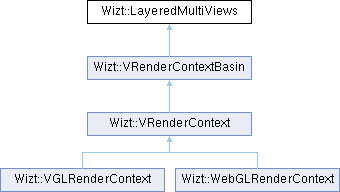
Classes | |
| struct | Layers |
Public Types | |
| using | LayeredViews_t = std::vector<ProjectionLayerViews_t> |
| Data structure for the internal LayeredViews member, which is indexed by: | |
Public Member Functions | |
| View & | CurrentView (unsigned Eye, unsigned int ViewportIndex=0) |
| Access the view of the current eye for the current projection layer such that it can be modified. | |
| const View & | CurrentView (unsigned Eye, unsigned int ViewportIndex=0) const |
| Access the view of the current eye for the current projection layer. | |
| const View & | getWorldView (unsigned Eye, unsigned int ViewportIndex=0) const |
| Access to the world view parameters, which are valid after the camera objects have been rendered. | |
| bool | isValid (const Anemone &) const |
| Check whether the Anemone is non-empty and the number of views in the Anemone matches the current settings. | |
| glsl | MultiViewPrefix (bool Define_num_views_layout=true, std::size_t MultiViewBindingPoint=0) const |
| Define in GSL. | |
| void | setNumberOfEyes (unsigned NumberOfEyes) |
| Change the number of views that are available for rendering. | |
Public Attributes | |
| int | CurrentEye = 0 |
| Stereo support: 0 ... cyclops, no stereo +1 ... right eye Any other numbers may be used to indicate eyes that are shifted even wider. | |
| int | MultiViewOutput = 1 |
| Requested views that are available for output at once. | |
Static Public Attributes | |
| static constinit char | DefineStructView [] |
| Define the View structure in GLSL that defines the modelview and projection matrices plus the camera parameters. | |
| static constexpr unsigned | MaxViewports = 16 |
| Maximally allowed number of viewports. | |
Detailed Description
Handling multiple views in multiple layers in multiple viewports.
Member Typedef Documentation
◆ LayeredViews_t
| using Wizt::LayeredMultiViews::LayeredViews_t = std::vector<ProjectionLayerViews_t> |
Data structure for the internal LayeredViews member, which is indexed by:
whereby the outermost index range is dynamic and determined at runtime, i.e. the number of eyes determined at runtime depending on whether the output is stereo or some multi-display environment.
Member Function Documentation
◆ getWorldView()
| const View & Wizt::LayeredMultiViews::getWorldView | ( | unsigned | Eye, |
| unsigned int | ViewportIndex = 0 ) const |
Access to the world view parameters, which are valid after the camera objects have been rendered.
This call allows, for instance, overlay objects to access the world view parameters.
References MaxViewports.
◆ MultiViewPrefix()
|
inline |
Define in GSL.
- the struct View as in DefineStructView
- the num_views layout for multiview
- multiview_transform* functions
◆ setNumberOfEyes()
| void Wizt::LayeredMultiViews::setNumberOfEyes | ( | unsigned | NumberOfEyes | ) |
Change the number of views that are available for rendering.
Some Lens object may specify that we want to render multiple views even on a single output device.
The VRenderContext::NumberOfOutputChannels is the number of screens available in hardware for rendering.
Member Data Documentation
◆ DefineStructView
|
staticconstinit |
Define the View structure in GLSL that defines the modelview and projection matrices plus the camera parameters.
◆ MaxViewports
|
staticconstexpr |
Maximally allowed number of viewports.
This limit is imposed by OpenGL.
Referenced by CurrentView(), CurrentView(), and getWorldView().
◆ MultiViewOutput
| int Wizt::LayeredMultiViews::MultiViewOutput = 1 |
Requested views that are available for output at once.
This would be identical to the number of eyes during a multiview rendering an one for a single view rendering with multiple passes.
Referenced by Wizt::VGLRenderContext::render().
Generated on for The Vish Visualization Shell by
 1.16.1