Wizt::Enum Struct Reference
Enumeration type. More...
#include <ocean/shrimp/VEnum.hpp>
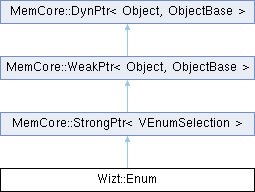
Inheritance diagram for Wizt::Enum:
Public Member Functions | |
| bool | addCase (const string &s) |
| Add a possible choice to this enum. Usually only used during construction. | |
| template<typename... Arguments> | |
| bool | addCase (const string &Value, Arguments... parameters) |
| Recursive handling of parameter pack. | |
| int | Case (const char *s0, const char *s1=0, const char *s2=0, const char *s3=0, const char *s4=0, const char *s5=0, const char *s6=0, const char *s7=0, const char *s8=0, const char *s9=0, const char *sa=0) const |
| Find the enum entry in the given list of possible values, return the number in the entries. | |
| Enum () | |
| Empy enum. | |
| Enum (const char *entries[], unsigned howmany) | |
| Initialize Enumeration type from list of strings. | |
| Enum (const MemCore::StringList &SL) | |
| Construct from a given string list. | |
| Enum (const string &path, char delimiter) | |
| Construct from a given string with delimiter character. | |
| template<typename... Arguments> | |
| Enum (const string &s1, Arguments... parameters) | |
| template<typename... Arguments> | |
| Enum (unsigned i, const string &s1, Arguments... parameters) | |
| bool | Equal (const string &what) const |
| Check if the enumeration has the given value. | |
| int | iCase (const char *s0, const char *s1=0, const char *s2=0, const char *s3=0, const char *s4=0, const char *s5=0, const char *s6=0, const char *s7=0, const char *s8=0, const char *s9=0, const char *sa=0) const |
| Same as Case(), but using stricmp(). | |
| bool | iEqual (const string &what) const |
| Check if the enumeration has the given value, ignoring upper/lower case. | |
| string | operator() () const |
| Get the currently selected enumeration string. | |
| int | operator() (const char *entries[], unsigned howmany) const |
| Find the enum entry in the given list of possible values, return the number in the entries. | |
| int | operator() (const RefPtr< StringList > &SL) const |
| Find the enum entry in the given list of possible values, return the number in the entries. | |
| bool | operator() (const string &what) const |
| Check if the enumeration has the given value Same as calling Equal(). | |
| Public Member Functions inherited from MemCore::StrongPtr< Object, ObjectBase > | |
| StrongPtr & | assignStrong (const DynPtr_t &other) |
| assign a strong pointer from a weak pointer | |
| StrongPtr & | assignStrong (const ReferenceBase< ObjectBase_t > *Obj) |
| assign a strong pointer from a native pointer | |
| StrongPtr & | assignStrong (const std::nullptr_t &) |
| Assign nullptr to a strong pointer, which will remove the referenced object if its counter reaches zero, but the pointer will remain a valid weak pointer with sustained hash value (the referer will still be around). | |
| template<typename... Arguments> | |
| auto | operator() (Arguments...parameters) const -> decltype((*this->getPtrValue())(parameters...)) |
| Function call operator forwarding. | |
| refvalue_t & | operator* () const |
| The dereferencing *-operator. | |
| pointer_t | operator-> () const |
| The pointer operator. | |
| StrongPtr & | operator= (const DynPtr_t &other) |
| Assignment operator, same as assignStrong(). | |
| StrongPtr & | operator= (const ReferenceBase< ObjectBase_t > *Obj) |
| Assignment from object base class pointer. | |
| StrongPtr & | operator= (const std::initializer_list< StrongPtr > &other) |
| Syntactic sugar: Allows assignment with {} to create a nullptr. | |
| StrongPtr & | operator= (const std::nullptr_t &) |
| Assignment operator with nullptr, invalidate. | |
| StrongPtr & | operator= (const StrongPtr &other) |
| Assignment operator, same as assignStrong(). | |
| template<class IndexType> | |
| auto | operator[] (const IndexType &I) const -> decltype((*this->getPtrValue())[I]) |
| Index operator forwarding. | |
| StrongPtr () | |
| Default constructor (makes a NULL pointer). | |
| StrongPtr (const ReferenceBase< ObjectBase_t > *Obj) | |
| Strong pointer from reference base of object, eg. via new operator. | |
| StrongPtr (const ReferenceBase< ObjectBase_t > *Obj, const NotNullPtr &) | |
| Strong pointer from reference base of object, eg. via new operator. | |
| StrongPtr (const std::nullptr_t &) | |
| Explicitely construct a nullptr pointer. | |
| template<class ChildObject> | |
| StrongPtr (const StrongPtr< ChildObject, ObjectBase > &Other) | |
| Reference pointer with dynamic type identification. | |
| StrongPtr (const StrongPtr< Object, ObjectBase > &Other) | |
| Copy constructor. | |
| template<class ChildObject> | |
| StrongPtr (const WeakPtr< ChildObject, ObjectBase_t > &Other) | |
| Reference pointer with dynamic type identification. | |
| ~StrongPtr () | |
| Destructor, the last one cleans up and destructs the object itself. | |
| pointer_t | getPtrValue () const |
| The pointer value, checked for null. | |
| pointer_t | operator-> () const |
| The pointer operator. | |
| refvalue_t & | operator* () const |
| The dereferencing *-operator. | |
| size_t | operator~ () const |
| Convenience operator to easily retrieve the object count ID of the referenced object, a unique number for each instance. | |
| WeakPtr () | |
| Default constructor, makes a NULL pointer. | |
| WeakPtr (const std::nullptr_t &) | |
| Explicitely construct NULL pointer. | |
| WeakPtr (const ReferenceBase< ObjectBase > *Obj) | |
| Weak pointer from reference base of object. | |
| WeakPtr (const ReferenceBase< ObjectBase > *Obj, const NotNullPtr &) | |
| Weak pointer from reference base of object which must not be null. | |
| template<class AnyObject> | |
| WeakPtr (const WeakPtr< AnyObject, ObjectBase > &Other) | |
| Weak pointer from pointer to another class. | |
| WeakPtr (const WeakPtr &Other) | |
| Copy constructor. | |
| ~WeakPtr () | |
| Default destructor, removes weak references to the object, the last one cleans up the referrer proxy object. | |
| WeakPtr & | assignWeak (const WeakPtr &other) |
| Assign a weak pointer (explicit function call, same as assignment operator for weak pointers). | |
| WeakPtr & | operator= (const WeakPtr &other) |
| Assignment operator (same as assignWeak() ). | |
| Public Member Functions inherited from MemCore::DynPtr< Object, ObjectBase > | |
| const DynPtr & | getDynPtr () const noexcept |
| Convenience type cast to dynamic pointer class. | |
| const type_info & | getType () const noexcept |
| Return type info of associated object, typeid(NullPtr) or typeid(void) if none. | |
| bool | isAssignable (const DynPtr< ObjectBase, ObjectBase > &Other) const noexcept |
| Check whether a given pointer to a base class may be assigned to a pointer of the derived class. | |
| operator void * () const noexcept | |
| Check if the pointer is valid. | |
| bool | operator! () const noexcept |
| Check if the pointer is invalid. | |
| void | speak (const char *s, const char *prefix="") const noexcept |
| Print some debug messages to the console. | |
Additional Inherited Members | |
| Public Types inherited from MemCore::StrongPtr< Object, ObjectBase > | |
| typedef WeakPtr< Object, ObjectBase >::ObjectBase_t | ObjectBase_t |
| Exporting the base class of the reference counted objects. | |
| Public Types inherited from MemCore::WeakPtr< Object, ObjectBase > | |
| typedef Object | object_t |
| Exporting the type of the derived class. | |
| typedef ObjectBase | ObjectBase_t |
| Exporting the type of the base class. | |
| typedef RefPtrTypeTrait< Object, ObjectBase >::ReferencePointerType | pointer_t |
| The result type of the pointer operator, may be changed with the RefPtrTypeTrait<> class. | |
| typedef RefPtrTypeTrait< Object, ObjectBase >::ReferenceValueType | refvalue_t |
| The result of the dereferencing operator, may be changed with the RefPtrTypeTrait<> class. | |
| Public Types inherited from MemCore::DynPtr< Object, ObjectBase > | |
| typedef Object | object_t |
| Type of the associated object. | |
| Static Public Member Functions inherited from MemCore::DynPtr< Object, ObjectBase > | |
| static const DynPtr & | getNullPtr () noexcept |
| Associated static NullPtr - avoids creation of a temporary object when a reference is needed. | |
| Protected Member Functions inherited from MemCore::WeakPtr< Object, ObjectBase > | |
| WeakPtr (Object *that, const SelfInitialize &) | |
| Internal constructor used when initializing an object with its own self-reference. | |
| Protected Member Functions inherited from MemCore::DynPtr< Object, ObjectBase > | |
| template<class AnyObject> | |
| DynPtr (const DynPtr< AnyObject, ObjectBase > &Other) noexcept | |
| Implicit type conversion within the same class hierarchy Any pointer. | |
| DynPtr (const std::nullptr_t &) noexcept | |
| Assign from nullptr. | |
| void | Speak (const char *s, const char *prefix="") const |
| Verbose information printing for this pointer. | |
Detailed Description
Enumeration type.
Enumeration types are a list of strings out of which one element can be selected. Application code needs to check for the existence of a specific string. Note that enumeration types can be shared with any other enumeration type, so the requested match might possibly not be contained in the input list. As of now there is no way to prevent connecting incompatible enumeration types.
To ease the use of enum's some mechanisms are provided that allow using the enumeration value as part of a switch() statement similar to a native string.
static const char* operations[] =
{ "add", "sub", "mult", "div", "pow", "max", "min" };
enum { ADD , SUB , MULT , DIV , POW , MAX , MIN };
class MyObject : public VObject
{
TypedSlot<Enum> Operation;
public:
MyObject(...)
: VObject(...)
, Operation(this, "operation", Enum( operations, 7) )
{}
bool update(VRequest&R, double precision) override
{
Enum operation;
Operation << R >> operation;
switch( operation(operations, 7) )
{
case ADD: r = x + m; break;
case SUB: r = x - m; break;
case MULT: r = x * m; break;
case DIV: r = x / m; break;
case MAX: r = (x > m)? x:m; break;
case MIN: r = (x < m)? x:m; break;
default: break;
}
if (operation("add") )
{
...
}
}
};
rotor pow(const rotor &r, double t)
Compute the power of a rotor.
Definition rotor3.hpp:409
Constructor & Destructor Documentation
◆ Enum() [1/2]
template<typename... Arguments>
|
inline |
       Create an enum type with its possible selections given
       as strings, for instance:
References addCase().
◆ Enum() [2/2]
template<typename... Arguments>
|
inline |
Member Function Documentation
◆ Case()
| int Wizt::Enum::Case | ( | const char * | s0, |
| const char * | s1 = 0, | ||
| const char * | s2 = 0, | ||
| const char * | s3 = 0, | ||
| const char * | s4 = 0, | ||
| const char * | s5 = 0, | ||
| const char * | s6 = 0, | ||
| const char * | s7 = 0, | ||
| const char * | s8 = 0, | ||
| const char * | s9 = 0, | ||
| const char * | sa = 0 ) const |
Find the enum entry in the given list of possible values, return the number in the entries.
VEnum enumValue;
{
case 0: // a
case 1: // b
case 2: // c
case -1: // not found
}
int Case(const char *s0, const char *s1=0, const char *s2=0, const char *s3=0, const char *s4=0, const char *s5=0, const char *s6=0, const char *s7=0, const char *s8=0, const char *s9=0, const char *sa=0) const
Find the enum entry in the given list of possible values, return the number in the entries.
Definition VEnum.cpp:304
Generated on for The Vish Visualization Shell by
 1.16.1