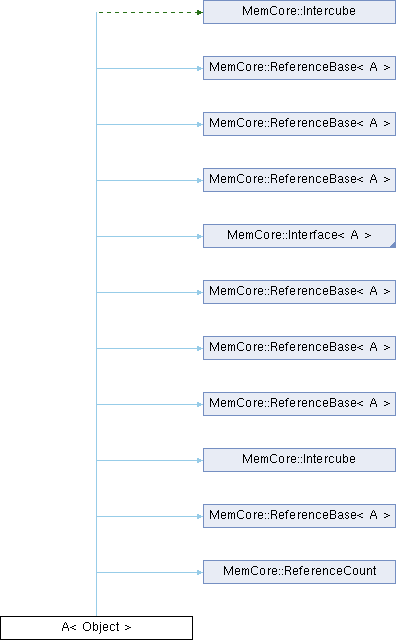
Public Member Functions | |
| A (Object *SomeObject) | |
| Construct referer object from newly created objects, sets reference counts to zero. | |
| void | extremeUnction () override |
| A virtual function that will be called just before the object is destroyed. | |
| void | extremeUnction () override |
| A virtual function that will be called just before the object is destroyed. | |
| void | extremeUnction () override |
| A virtual function that will be called just before the object is destroyed. | |
| void | extremeUnction () override |
| A virtual function that will be called just before the object is destroyed. | |
| Public Member Functions inherited from MemCore::Intercube | |
| void | addInterface (const RefPtr< InterfaceBase > &I) const |
| Add an interface class object. | |
| template<class Data, typename TypeSelector> | |
| void | addInterfaceData (const Data &D) |
| Add data via an interface class object. | |
| template<class Data> | |
| void | addInterfaceData (const Data &D) |
| Add data via an interface class object. | |
| void | clearInterfaces () |
| Remove all interfaces. | |
| bool | const_iterateInterfaces (const RefPtr< InterfaceIterationParameter > &IIP) const |
| Constant iterator. | |
| virtual RefPtr< InterfaceBase > | createInterface (const type_info &) const |
| Virtual function which allows derived objects to create Interface objects on demand. | |
| RefPtr< InterfaceBase > | findInterface (const type_info &t) const |
| Find a certain interface of specified type. | |
| RefPtr< InterfaceBase > | getInterface (const type_info &t) |
| Retrieve an interface object from a certain type. | |
| std::string | getInterfaceNames (const char delim=';') const |
| Debug function retrieving all interfaces as human-readable string. | |
| template<class Data> | |
| bool | gotNewInterfaceData (const Data &D) |
| Check whether data on the given interface have changed, and if so, set new data as interface. | |
| template<class Data, typename Selector> | |
| bool | gotNewInterfaceData (mutex &M, const Data &D) |
| Check whether interface data have changed, if so, then set new interface data and return true. | |
| template<class Data> | |
| bool | gotNewInterfaceData (mutex &M, const Data &D) |
| Check whether interface data have changed, if so, then set new interface data and return true. | |
| template<class Data, typename Selector> | |
| bool | gotNewInterfaceData (mutex &M, const Data &D, const Selector &S) |
| Check whether interface data have changed, if so, then set new interface data and return true. | |
| template<class Data, typename Selector> | |
| bool | gotNewInterfaceData (mutex &M, const Data &D, const Selector *S) |
| Check whether interface data have changed, if so, then set new interface data and return true. | |
| template<class Data, typename Selector> | |
| bool | hasChangedInterfaceData (const Data &D) const |
| Check whether interface data have changed. | |
| template<class Data> | |
| bool | hasChangedInterfaceData (const Data &D) const |
| Check whether interface data have changed. | |
| template<class Data, typename Selector> | |
| bool | hasChangedInterfaceData (const Data &D, const Selector &) const |
| Check whether interface data have changed. | |
| template<class Data, typename Selector> | |
| bool | hasChangedInterfaceData (const Data &D, const Selector *) const |
| Check whether interface data have changed. | |
| bool | hasInterface (const type_info &t) const |
| Check if some Interface might exist. | |
| Intercube () | |
| Constructor. | |
| bool | iterateInterfaces (const RefPtr< InterfaceIterationParameter > &IIP) |
| Modifyable iterator. | |
| void | printInterfaces () const |
| Debug function that prints the names of all interfaces. | |
| void | registerInterface (const type_info &t) |
| Register an interface type; when the interface is actually required, the virtual createInterface() function will be called. | |
| template<class InterfaceType> | |
| void | removeInterface () |
| Remove an interface. | |
| void | removeInterfaceBase (const type_info &InterfaceBaseID) |
| Remove an interface. | |
| virtual | ~Intercube () |
| Destructor. | |
| Public Member Functions inherited from MemCore::ReferenceBase< A > | |
| auto | getObjectCountID () const noexcept |
| Get a unique ID for this object in the given domain. | |
| bool | isIdentical (const WeakPtr< A, A > &PossibleSelf) const noexcept |
| Check if this object is identical to the one used by the given pointer. | |
| void | mkAutoDestructive () |
| Marks this object as being automatically destructed, e.g. | |
| refcount_t | refcount () const noexcept |
| The strong reference count. | |
| ReferenceBase (A *that) noexcept | |
| Constructor, initializes reference counter to zero. | |
| const auto & | self () const |
| Return weak pointer to the object self. | |
| refcount_t | wrefcount () const noexcept |
| The weak reference count. | |
| Public Member Functions inherited from MemCore::Interface< A > | |
| const type_info & | getInterfaceDomain () const |
| Run-time information about the type used for InterCube registration. | |
| Public Member Functions inherited from MemCore::InterfaceBase | |
| virtual bool | apply (Intercube &I, const RefPtr< InterfaceIterationParameter > &) |
| modifyable callback function | |
| virtual bool | apply_const (const Intercube &I, const RefPtr< InterfaceIterationParameter > &) |
| constant callback function | |
| InterfaceBase () throw () | |
| Constructor. | |
| Public Member Functions inherited from MemCore::ReferenceBase< InterfaceBase > | |
| auto | getObjectCountID () const noexcept |
| Get a unique ID for this object in the given domain. | |
| bool | isIdentical (const WeakPtr< InterfaceBase, InterfaceBase > &PossibleSelf) const noexcept |
| Check if this object is identical to the one used by the given pointer. | |
| void | mkAutoDestructive () |
| Marks this object as being automatically destructed, e.g. | |
| refcount_t | refcount () const noexcept |
| The strong reference count. | |
| ReferenceBase (InterfaceBase *that) noexcept | |
| Constructor, initializes reference counter to zero. | |
| const auto & | self () const |
| Return weak pointer to the object self. | |
| refcount_t | wrefcount () const noexcept |
| The weak reference count. | |
Additional Inherited Members | |
| Public Types inherited from MemCore::ReferenceBase< A > | |
| using | reference_domain_t |
| The type of the base class. | |
| using | SelfPtr_t |
| Type for a pointer to this object itself. | |
| Public Types inherited from MemCore::Interface< A > | |
| using | InterfaceDomain_t |
| Compile-time information about the type used for InterCube registration. | |
| Public Types inherited from MemCore::ReferenceBase< InterfaceBase > | |
| using | reference_domain_t |
| The type of the base class. | |
| using | SelfPtr_t |
| Type for a pointer to this object itself. | |
| Protected Member Functions inherited from MemCore::ReferenceBase< A > | |
| ReferenceBase & | operator= (const ReferenceBase &R) |
| Protected assignment operator (should not be called). | |
| void | suicide () |
| Delete this. | |
| virtual | ~ReferenceBase () |
| Virtual destructor. | |
| Protected Member Functions inherited from MemCore::InterfaceBase | |
| ~InterfaceBase () | |
| Destructor. | |
| Protected Member Functions inherited from MemCore::ReferenceBase< InterfaceBase > | |
| ReferenceBase & | operator= (const ReferenceBase &R) |
| Protected assignment operator (should not be called). | |
| void | suicide () |
| Delete this. | |
| virtual | ~ReferenceBase () |
| Virtual destructor. | |
| Protected Member Functions inherited from MemCore::ReferenceCount | |
| ReferenceCount () noexcept | |
| Initialize reference counts to zero. | |
| bool | canIncrementStrongRefsEvenMore () const noexcept |
| The "extreme unction" state is when a pointer is determined to die sure, and this state is set by the suicide() function. | |
| refcount_t | get_pointers () const noexcept |
| Return the weak reference count, i.e. | |
| refcount_t | get_refs () const noexcept |
| Return the strong reference count, i.e. | |
| refcount_t | weak_refcount () const noexcept |
| Return the weak reference count, i.e. | |
| Protected Attributes inherited from MemCore::ReferenceCount | |
| interlocked_t | strong_refs |
| Strong references. | |
| interlocked_t | weak_refs |
| Weak references. | |
| Static Protected Attributes inherited from MemCore::ReferenceCount | |
| static constexpr refcount_t | dead_object_refcount = -111L |
| Some unrealistically large value that is used during premature destruction of objects to indicate that they are still alive even though they will be killed soon after. | |
| static constexpr refcount_t | max_object_refcount = 0x39000000L |
| Maximum value that a reference count can reach before it overflows. | |
| static constexpr refcount_t | null_referencer = -222L |
| Magic number to indicate that a reference refers to a non-existent reference, i.e. | |
Member Function Documentation
◆ extremeUnction() [1/4]
|
inlineoverridevirtual |
A virtual function that will be called just before the object is destroyed.
It will be called while the reference count is just zero, thus reference pointers are still (barely!) valid to this object. An implementation of this function is like a virtual destructor with yet intact reference pointers, whereas in a virtual destructor all reference pointers have already been invalidated. Consequently, the object itself is still valid when this function is called, but it will no longer be considered valid once the destructor is called.
Reimplemented from MemCore::ReferenceBase< A >.
References MemCore::ReferenceBase< A >::self().
◆ extremeUnction() [2/4]
|
inlineoverridevirtual |
A virtual function that will be called just before the object is destroyed.
It will be called while the reference count is just zero, thus reference pointers are still (barely!) valid to this object. An implementation of this function is like a virtual destructor with yet intact reference pointers, whereas in a virtual destructor all reference pointers have already been invalidated. Consequently, the object itself is still valid when this function is called, but it will no longer be considered valid once the destructor is called.
Reimplemented from MemCore::ReferenceBase< A >.
References MemCore::ReferenceBase< A >::self().
◆ extremeUnction() [3/4]
|
inlineoverridevirtual |
A virtual function that will be called just before the object is destroyed.
It will be called while the reference count is just zero, thus reference pointers are still (barely!) valid to this object. An implementation of this function is like a virtual destructor with yet intact reference pointers, whereas in a virtual destructor all reference pointers have already been invalidated. Consequently, the object itself is still valid when this function is called, but it will no longer be considered valid once the destructor is called.
Reimplemented from MemCore::ReferenceBase< A >.
References MemCore::ReferenceBase< A >::self().
◆ extremeUnction() [4/4]
|
inlineoverridevirtual |
A virtual function that will be called just before the object is destroyed.
It will be called while the reference count is just zero, thus reference pointers are still (barely!) valid to this object. An implementation of this function is like a virtual destructor with yet intact reference pointers, whereas in a virtual destructor all reference pointers have already been invalidated. Consequently, the object itself is still valid when this function is called, but it will no longer be considered valid once the destructor is called.
Reimplemented from MemCore::ReferenceBase< A >.
References MemCore::ReferenceBase< A >::self().
Generated on for The Vish Visualization Shell by
 1.16.1