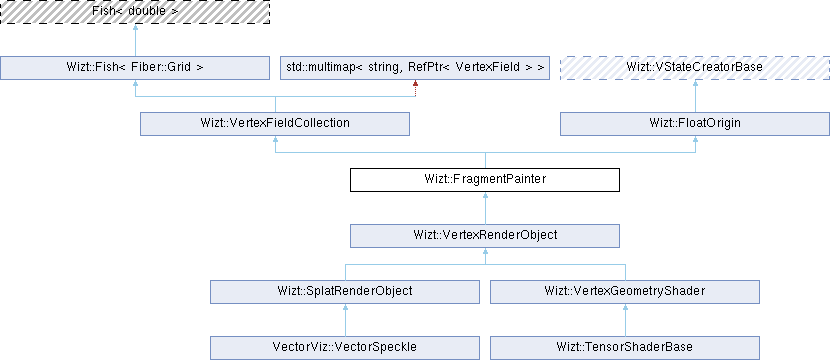
A helper class that supports rendering of a collection of fragments from various fields. More...
#include <FragmentPainter.hpp>
Public Member Functions | |
| FragmentPainter (VObject *that, const string &fragmentselectorname="selection", int EL=5) | |
| Constructor, needs a VObject to initialize the slot driving the fragment selector. | |
| virtual string | FragmentSelectionField () const |
| Return the name of the field that will be responsible for the coordinates of the fields. | |
| virtual string | GLCacheField (const RefPtr< ValuePool > &Context) const |
| The name of the field that will be used for caching opengl VBO's at each of this fragments. | |
| virtual RefPtr< ValueSet > | CacheableVariables (const RefPtr< ValuePool > &Context) const |
| Return a set of variables for which the results shall be cached, i.e. | |
| virtual string | VBOCacheKey (const RefPtr< ValuePool > &Context) const |
| A child-class defined arbitrary string used to extend the cache modifier. | |
| virtual RefPtr< VBO::Renderer > | createRenderer (VGLRenderContext &Context, const RefPtr< MemBase > &FieldCoordinates, const RefPtr< FragmentSelector > &FS) const |
| Create a Renderer object for the VBO, which by default is a DrawArrays() renderer that emits points for each vertex. | |
| virtual void | updateRenderer (VGLRenderContext &Context, const RefPtr< VBO::Renderer > &R, const RefPtr< MemBase > &FieldCoordinates, const RefPtr< FragmentSelector > &FS) const |
| Update a renderer object, in case the fragment selector is newer. | |
| virtual Ageable | YoungestDependency (const RefPtr< ValuePool > &Context, const WeakPtr< Representation > &RefinementRep) const |
| Optional child class for specifying dependencies that may have changed and require re-creation of a cached VBO. | |
| virtual bool | appendOnDemandFragments (VGLRenderContext &Context, const RefPtr< VBO > &myVBO, int RefinementLevel, const WeakPtr< Representation > &RefinementRep, const RefPtr< FragmentID > &fragment_identifier, const Fiber::Fragment &FragmentData, const RefPtr< GLProgram > &Shader) const |
| Virtual function to allow derived classes to create data on demand, i.e. | |
| virtual void | setRendererParameters (VGLRenderContext &Context, const RefPtr< VBO::Renderer > &theRenderer, const RefPtr< CreativeArrayBase > &VertexCoordinates, const RefPtr< GLProgram > &theShaderProgram) const =0 |
| Given a Renderer, which usually is has been created by the createRenderer() virtual function, modify its parameters, depending on the context. | |
| virtual bool | FunctorsAreOlderThan (const Ageable &A, const RefPtr< ValuePool > &Context) const |
| virtual void | updateFromFunctorsAge (Ageable &A, const RefPtr< ValuePool > &Context) const |
| void | renderFragments (Fiber::FragmentCluster &FC, VGLRenderContext &Context, VGLRenderObject::UsedVBO_t &UsedVBO, const RefPtr< GLProgram > &myProgram) const |
| Render all the field fragments that are stored and available here. | |
| Public Member Functions inherited from Wizt::VertexFieldCollection | |
| VertexFieldCollection (VObject *that) | |
| Construct a collection of fields on the vertices of a Grid. | |
| ~VertexFieldCollection () | |
| Destructor. | |
| TypedSlot< Fiber::Field > & | insertVertexField (const string &s, const RefPtr< VertexField > &) |
| Add a vertex field under the given name. | |
| RefPtr< VertexField > & | operator[] (const string &s) |
| Retrieve a VertexField for the given name, create one, if required. | |
| RefPtr< VertexField > | operator() (const string &s) const |
| Search for a VertexField under the given name. | |
| Fiber::Info< Fiber::Skeleton > | getRefinementLevel (int Level, const RefPtr< ValuePool > &VP, int IndexDepth=0, const Fiber::BundlePtr &SpaceTime=Fiber::BundlePtr(NullPtr())) const override |
| Implementation of the virtual callback function that will load data sets from a grid into a collection of VertexFields, as specified earlier. | |
| virtual GridSelector | myGridSelector (const RefPtr< ValuePool > &VP) const |
| Virtual function that allows child classes to specify the Grid that shall be used. | |
| GridSelector | getGridSelector (const RefPtr< ValuePool > &VP) const override |
| Get the Grid that will be used here. | |
| void | retrieveFields (Fiber::FieldCollection &FieldMap, const RefPtr< Fiber::Representation > &MyRepresentation, const RefPtr< ValuePool > &Context, const RefPtr< Fiber::Skeleton > &DestVertices, Fiber::Grid &DestGrid, Fiber::Slice &DestGridSlice, const string &HelperDestGridName, bool StoreResult=true) |
| From the given Representation, retrieve all fields as required here into the provided Fieldmap. | |
| int | append (const RefPtr< VBO > &myVBO, const VertexFragment &VertexFragments, const RefPtr< GLProgram > &Shader) const |
| Append all the fields stored in these vertex fragments to the given vertex buffer object. | |
| bool | isOlderThan (const Ageable &A, const RefPtr< ValuePool > &Context) const |
| Check if all parameters in this collection of fields is older than the given age. | |
| void | updateAge (Ageable &A, const RefPtr< ValuePool > &Context) const |
| RefPtr< StringList > | getCurrentFieldnames (const RefPtr< ValuePool > &Context) const |
| Get a list of all currently selected fields. | |
| int | iterate (Iterator &It) const |
| Iterate through all available vertex fields. | |
| Public Member Functions inherited from Wizt::Fish< Fiber::Grid > | |
| Fish (const string &s="grid", int prior=2) | |
| Constructor, optionally pass a parameter of this grid's name (ie. | |
| virtual | ~Fish () |
| Destructor. | |
| void | registerGridAsOutput () |
| Make grid visible as output. | |
| Fiber::Bundle::GridInfo_t | findMostRecentGrid (GridSelector &GS, const RefPtr< ValuePool > &VP, const Fiber::BundlePtr &SpaceTime=Fiber::BundlePtr(NullPtr())) const |
| This is a convenience function to find the most recent grid for the current time ( Fish<Slice>() or virtual function getTime() ). | |
| Fiber::Bundle::GridInfo_t | findMostRecentGrid (const RefPtr< ValuePool > &VP, const Fiber::BundlePtr &SpaceTime=Fiber::BundlePtr(NullPtr())) const |
| Find the most recent grid for the current time ( Fish<Slice>() or virtual function getTime() ). | |
| bool | IterateLevelsOnMostRecentGrid (LevelIterator &LI, const RefPtr< ValuePool > &Context, const Fiber::BundlePtr &SpaceTime=Fiber::BundlePtr(NullPtr())) const |
| Iterate over all the selected levels of a Grid via an instance of the LevelIterator. | |
| RefPtr< Fiber::Field > | getField (const Fiber::FieldSelector &FS, const RefPtr< ValuePool > &VP, const Fiber::BundlePtr &SpaceTime=Fiber::BundlePtr(NullPtr())) |
| Retrieve a field for the given FieldSelector on the currently selected Grid. | |
| Public Member Functions inherited from Wizt::Fish< double > | |
| Fish () | |
| Default constructor. | |
| ~Fish () | |
| Destructor. | |
| virtual double | getTime (const RefPtr< ValuePool > &VP, const RefPtr< Fiber::Bundle > &SpaceTime) const =0 |
| Most virtual time retrieval function. | |
| virtual int | getMaxRefinementLevel (const RefPtr< ValuePool > &VP) const |
| Get the maximum refinement level that we seek to handle here. | |
| virtual int | getMinRefinementLevel (const RefPtr< ValuePool > &VP) const |
| bool | IterateLevels (LevelIterator &LI, const Fiber::Info< Fiber::Grid > &G, const RefPtr< ValuePool > &Context) const |
| Iterate over the diverse refinement levels of a Grid, which may exist at times different from the given coarsest grid. | |
| Public Member Functions inherited from Wizt::VConnectable | |
| virtual void | adjustConnections (const RefPtr< VSlot > &ChangedSlot, const RefPtr< VParameter > &par) |
| VSlotContainer::AttachErrorCode | attach (const ParameterID &whichone, VSlotContainer &sourceObject, const ParameterID &sourceName) |
| AttachErrorCode | attach (const RefPtr< VParameter > &OldParam, const RefPtr< VParameter > &NewParam, const string &Member={}) |
| AttachErrorCode | attachUniqueObject (const RefPtr< VParameter > ¶m, const RefPtr< VCreationPreferences > &VCP=NullPtr(), bool ReallyUnique=true) |
| AttachErrorCode | attachUniqueObject (const RefPtr< VSlot > &slot, const RefPtr< VCreationPreferences > &VCP=NullPtr(), bool ReallyUnique=true) |
| RefPtr< VSlot > | Connect (const RefPtr< VParameter > &SourceParam) |
| RefPtr< VSlot > | ConnectInterface (const RefPtr< VSlotContainer > &Provider, const RefPtr< InterfaceBase > &IB) |
| virtual bool | CreatedFilteredConnection (const RefPtr< VParameter > &SourceParam) |
| Public Member Functions inherited from Wizt::VSlotContainer | |
| Ageable & | age (const RefPtr< ValuePool > &VP) |
| const Ageable & | age (const RefPtr< ValuePool > &VP) const |
| const Ageable & | ConnectionAge () const |
| bool | ConnectionsHaveChanged (const RefPtr< ValuePool > &VP) const |
| bool | HasYoungerInput (const RefPtr< ValuePool > &Context, int RecursionLevel=0) const |
| Ageable | YoungestInput (const RefPtr< ValuePool > &Context) const |
| Ageable | YoungestOutput (const RefPtr< ValuePool > &Context) const |
| Ageable | YoungestUncachedInput (const RefPtr< ValuePool > &Context) const |
| bool | CheckIfThereExistNewerOutputs (const VRequest &request, bool AdjustObjectAge) const |
| RefPtr< VSlot > | addParameter (const ParameterID &name, int EL, const RefPtr< VParameter > ¶m, bool overwriteExistingSlot) |
| virtual bool | allowParameterReplacement (const RefPtr< VParameter > &NewParam, const RefPtr< VParameter > &OldParam, const string &localName, int ExpertLevel) |
| virtual int | connectSlots (const VSlotContainerPtr &vobj) |
| bool | removeParameter (const ParameterID &s) |
| RefPtr< VParameter > | getParameter (const ParameterID &s) const |
| RefPtr< VSlot > | getSlot (const ParameterID &s, int &EL) const |
| bool | setSlotValueFromText (const ParameterID &s, const string &ValueText, const RefPtr< ValuePool > &VP, const string &theMember={}) |
| RefPtr< VSlot > | findSlot (const RefPtr< VParameter > ¶m) const |
| string | getSlotName (const RefPtr< VParameter > ¶m) const |
| bool | AddAction (const ParameterID &s, const RefPtr< ValueActionBase > &VAB) |
| bool | AddAction (const RefPtr< VSlot > &ActionSlot, bool(DerivedObject::*Action)(const RefPtr< VValueBase > &value)) |
| RefPtr< VParameter > | mkUniqueParameterInput (const ParameterID &s, const string &ContainerName) |
| int | getExpertLevel (const ParameterID &s) const |
| int | setExpertLevel (const ParameterID &s, int EL) |
| int | getExpertLevel (const RefPtr< VParameter > &) const |
| int | getExpertLevel (const RefPtr< VSlot > &S) const |
| int | setExpertLevel (const RefPtr< VSlot > &S, int EL) |
| int | setExpertLevel (const RefPtr< VParameter > &s, int EL) |
| bool | hasChanged (const ParameterID &s, const RefPtr< ValuePool > &Context) const |
| bool | hasChanged (const RefPtr< VSlot > &, const RefPtr< ValuePool > &Context) const |
| bool | hasChanged (const RefPtr< ValuePool > &Context, int n,...) const |
| bool | hasChanged (RefPtr< ValuePool > Context,...) const |
| virtual bool | ignoreInput (const RefPtr< VSlot > &theSlot) const |
| bool | getParameterValue (Type &Variable, const ParameterID &s, const RefPtr< ValuePool > &VP) const |
| bool | getParameterValue (Type &Variable, const ParameterID &s, const VContext &C) const |
| bool | getParameterValue (Type &Variable, const ParameterID &s, const VRequest &R) const |
| bool | setParameterValue (const Type &Variable, const ParameterID &s, const RefPtr< ValuePool > &VP, bool autoCreateLocalValue) const |
| bool | setParameterValue (const Type &Variable, const ParameterID &s, VContext &C, bool autoCreateLocalValue) const |
| bool | setParameterValue (const Type &Variable, const ParameterID &s, VRequest &R, bool autoCreateLocalValue=false) const |
| RefPtr< VSlot > | addParam (const ParameterID &name, const Type &init, const RefPtr< VCreationPreferences > &VP=NullPtr(), int expertLevel=0, bool overwriteExistingSlot=true) |
| bool | setParameterProperty (const ParameterID ¶m, const string &Properties, const RefPtr< VValueBase > &Value=NullPtr()) |
| RefPtr< VSlot > | addFloatParam (double init, const ParameterID ¶m, double min, double max, const RefPtr< VCreationPreferences > &IP=NullPtr(), int expertLevel=0) |
| AttachErrorCode | attach (const RefPtr< VParameter > &OldParam, const RefPtr< VParameter > &NewParam, const string &Member={}) |
| int | iterateParameters (int expertLevel, VSlotIterator &VIIt) const |
| int | iterateInputSlots (int expertLevel, VSlotIterator &VIIt) const |
| int | iterateInputs (VSlotIterator &VIIt, int expertLevel=0) |
| int | iterate_inputs (const std::function< bool(VSlot &what, int ExpertLevel)>) const |
| RefPtr< VSlot > | getUniqueInputSlot (const type_info &what) |
| int | getNumberOfParameters (int expertLevel) const |
| virtual bool | implements (const type_info &what) const |
| virtual RefPtr< VParameter > | getImplementation (const type_info &what, const string &name={}, const string &member={}) const |
| RefPtr< VSlot > | getImplementationSlot (const type_info &what, const string &Name={}, const string &Member={}) const |
| VAcceptInfoList_t | getAcceptInfoList (const std::type_info &request_type) const |
| bool | provides (const RefPtr< VSlot > &OutputSlot) const |
| RefPtr< VSlot > | findOutputSlot (const RefPtr< VParameter > &Who) const |
| bool | isYounger (const RefPtr< VParameter > &OutputParam, const RefPtr< ValuePool > &VP) const |
| bool | isNewlyConnected (const RefPtr< VParameter > &Who, const RefPtr< ValuePool > &VP) const |
| bool | hasNewlyConnectedOutputs (const RefPtr< ValuePool > &VP) const |
| void | findNewlyConnectedOutputs (const RefPtr< ValuePool > &VP, VSlotSet &WhichOnes) const |
| RefPtr< VSlot > | getOutput (const string &Name) const |
| RefPtr< MemCore::StringList > | getOutputs (const type_info &what=typeid(void)) const |
| virtual int | iterateOutputs (VOutputIterator &VOut, const type_info &just_these=typeid(void)) const |
| bool | registerOutput (const RefPtr< VParameter > &P, const string &AsName={}) |
| bool | registerOutput (const RefPtr< VParameter > &P, const string &AsName, const type_info &MemberType, const string &UseMember) |
| bool | registerOutput (const RefPtr< VParameter > &P, const type_info &MemberType, const string &UseMember) |
| int | getNumberOfInputs () const |
| int | getNumberOfOutputs () const |
| bool | hasChangedSlots (const MemCore::Intercube &IC, const RefPtr< ValuePool > &Context) const |
| auto | include_self (const std::tuple< SlotList... > &t) const -> decltype(std::tuple_cat(std::make_tuple(this), t)) |
| Public Member Functions inherited from MemCore::ReferenceBase< VManagedObjectBase > | |
| auto | getObjectCountID () const noexcept |
| bool | isIdentical (const WeakPtr< Object, Object > &PossibleSelf) const noexcept |
| void | mkAutoDestructive () |
| refcount_t | refcount () const noexcept |
| ReferenceBase (Object *that) noexcept | |
| const auto & | self () const |
| refcount_t | wrefcount () const noexcept |
| Public Member Functions inherited from Wizt::FloatOrigin | |
| RefPtr< Chunk< Eagle::point3 > > | computeShiftedCoordinates (const RefPtr< Chunk< Eagle::point3 > > &RawCoordinates, const Eagle::tvector3 &TranslationVector) const |
| VRenderContext::ModelViewState | getCoordinateTranslation (const VRenderContext &Context, Eagle::tvector3 &TranslationVector) const |
| VRenderContext::ModelViewState | getCoordinateTranslation (const VRenderContext &Context, Intercube &IC, Eagle::tvector3 &TranslationVector) const |
| Public Member Functions inherited from Wizt::VStateCreatorBase | |
| RefPtr< State > & | getState (const WeakPtr< ValuePool > &VP) const |
| RefPtr< InterfaceBase > | hasLocalInterface (const type_info &InterfaceType) const |
| RefPtr< State > | myState (const WeakPtr< ValuePool > &Context) const |
| virtual RefPtr< State > | newState () const |
| void | setState (const WeakPtr< ValuePool > &, const RefPtr< State > &st) const |
Public Attributes | |
| TypedSlot< FragmentSelector > | MyFragmentSelector |
| The input slot for selecting fragments out of a collection of fragments. | |
| TypedSlot< int > | MyNumOfRefFragments |
| TypedSlot< Options > | MyOptions |
| TypedSlot< double > | tsFloatOriginThreshold |
| Public Attributes inherited from Wizt::VertexFieldCollection | |
| RefPtr< VertexField > | Positions |
| The coordinates are a field that will always be available here. | |
| Public Attributes inherited from Wizt::Fish< Fiber::Grid > | |
| TypedSlot< Fiber::Grid > | MyGrid |
| Public Attributes inherited from Wizt::VSlotContainer | |
| AllLevels | |
| DestParameterNotFound | |
| InvalidDestParameter | |
Additional Inherited Members | |
| Public Types inherited from Wizt::VertexFieldCollection | |
| enum | { NumberOfInputFields = 1 } |
| Public Types inherited from Wizt::VSlotContainer | |
| enum | AttachErrorCode |
| typedef void | AcceptableInputTypes |
| typedef VSlotSet | CreationSlots_t |
| typedef VSlot::Empty< I > | Empty |
| Public Types inherited from MemCore::ReferenceBase< VManagedObjectBase > | |
| typedef Object | reference_domain_t |
| typedef WeakPtr< Object, Object > | SelfPtr_t |
| Static Public Member Functions inherited from Wizt::VConnectable | |
| static bool | attachSlot (const WeakPtr< VSlot > &DestSlot, const RefPtr< VParameter > &ProvidedParam, const string &Member={}) |
| static bool | attachSlot (const WeakPtr< VSlot > &DestSlot, const RefPtr< VSlot > &SourceSlot, const string &Member={}) |
| static bool | detachSlot (const RefPtr< VSlot > &SourceSlot) |
| Static Public Member Functions inherited from Wizt::VSlotContainer | |
| static const char * | AttachErrorCodeMessage (AttachErrorCode) |
| static bool | attachParameter (const RefPtr< VParameter > &theProvidedParam, const WeakPtr< VSlot > &theDestSlot, const string &theMember={}) |
| Static Public Member Functions inherited from Wizt::ValueCacheable | |
| static ValueCache & | consider (MemCore::Intercube &IC, const WeakPtr< VSlot > &VS, const RefPtr< ValuePool > &Context) |
| static ValueCache & | getValueCache (MemCore::Intercube &IC) |
| static bool | hasChangedSlots (const WeakPtrToVSlotContainer &theSlotOwner, const MemCore::Intercube &IC, const RefPtr< ValuePool > &Context) |
| Static Public Member Functions inherited from Wizt::FloatOrigin | |
| static VRenderContext::ModelViewState | getTranslationVector (const VRenderContext &Context, Intercube &IC, Eagle::tvector3 &TranslationVector, double CameraShiftThreshold) |
| static Eagle::tvector3 | getTranslationVector (Intercube &IC) |
| Protected Member Functions inherited from Wizt::VSlotContainer | |
| virtual void | setup (const CreationSlots_t &CreationSlots) |
| Protected Member Functions inherited from MemCore::ReferenceBase< VManagedObjectBase > | |
| virtual void | extremeUnction () |
| ReferenceBase & | operator= (const ReferenceBase &R) |
| void | suicide () |
Detailed Description
A helper class that supports rendering of a collection of fragments from various fields.
A collection of fragments may be all data sets of a fragmented field, as well as some subset of such that is determined by a FragmentSelector. For each geometrical region, there may be multiple fields available (as specified by the VertexFieldCollection), which are all shuffled to a collection of Vertex Buffer Object, ready to be used by some fragment shader that needs to be implemented in a child class.
Within the fragment shader, the respective field data will be available as arrays under the names under which they are stored in the VertexFieldCollection . For instance, the constructor of a child class would contain the following line:
It defines that the child class will use some input field named "vectorfield" that is provided to the fragment shader under the name "normalvectors".
Via the FragmentSelector this class also supports \i selective drawing of regions of interest.
Member Function Documentation
◆ appendOnDemandFragments()
|
virtual |
Virtual function to allow derived classes to create data on demand, i.e.
only when requested and required for rendering. Use in cooperation with YoungestDependency() to specify when a cached VBO shall be re-created. This function will never be called if those input data change otherwise.
◆ CacheableVariables()
|
virtual |
Return a set of variables for which the results shall be cached, i.e.
there resides an OpenGL object for each state of each of those variables. They are all kept in memory until the cache is full. A typical example are fields. So when the user switches from one field to another field, and back to the first one, the OpenGL object does not need to be recomputed again, but is retrieved from the Cache. A typical counter example is a floating point value, since that one has an infinite number of possibilities. And it is unlikely that a user will accidentally switch back to an old value of a float slider, thus caching relative to float values is not reasonable. It is still possible, however, and could make sense if float values are rounded.
A typical implementation of this function, assuming two slots "MyGrid" and "MyField") looks like this:
Reimplemented in Wizt::VertexRenderObject.
◆ createRenderer()
|
virtual |
Create a Renderer object for the VBO, which by default is a DrawArrays() renderer that emits points for each vertex.
The Renderer is kept alive as long as the VBO it belongs to is kept alive.
Reimplemented in Wizt::SplatRenderObject, and Wizt::VertexGeometryShader.
◆ FragmentSelectionField()
|
virtual |
Return the name of the field that will be responsible for the coordinates of the fields.
By default, this will be "Positions".
Referenced by GLCacheField(), and renderFragments().
◆ GLCacheField()
The name of the field that will be used for caching opengl VBO's at each of this fragments.
This is a temporary workaround. It will NOT work correctly if a VBO depends on multiple fields. The VBO will only change if the GLCacheField changes (ie., its fragments).
There will be ONE VBO per fragment of this GLCacheField.
Per default, this will be the FragmentSelectionField().
If a rendering method implements a vector field visualization of Grid that does not change, then this function would refer to the name of that vector field. However, if the coordinates changes but not the vector field, it will still display the same. This needs to be reworked.
Reimplemented in VectorViz::VectorSpeckle.
References FragmentSelectionField().
◆ setRendererParameters()
|
pure virtual |
Given a Renderer, which usually is has been created by the createRenderer() virtual function, modify its parameters, depending on the context.
In contrast to the cacheable variables (see CacheableVariables() ), these parameters that are modified here do not require re-creation of a VBO object. This function will be called just before the VBO object is called to re-render the already loaded data.
- Parameters
-
theShaderProgram The Program which will be used for rendering. It will be null if no Shader Program is used.
◆ VBOCacheKey()
A child-class defined arbitrary string used to extend the cache modifier.
Reimplemented in Wizt::TensorShaderBase.
◆ YoungestDependency()
|
virtual |
Optional child class for specifying dependencies that may have changed and require re-creation of a cached VBO.
This function is to be used in cooperation with appendOnDemandFragments().
Reimplemented in Wizt::TensorShaderBase.
References Wizt::Ageable::InfinitelyOld().
Generated by
 1.16.1