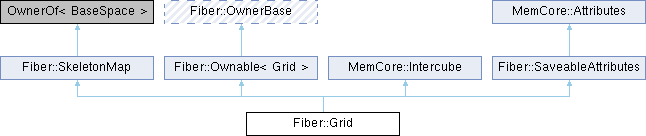
A Grid is a set of Skeleton objects, each of them accessed via some unique SkeletonID object. More...
#include <Grid.hpp>
Classes | |
| struct | FragmentFilter |
| Filter callback functions per fragment. More... | |
Public Types | |
| typedef Fiber::SkeletonInfo | SkeletonInfo |
| typedef SkeletonIterator | Iterator |
| Associated Iterator class. | |
| template<class index_type> | |
| using | filter = std::function<bool(Chunk<index_type>&indirection, const RefPtr<FragmentID>&fid, CreativeArrayBase&CAB)> |
| A filter function provided by a SkeletonFilter that fills the given indirection array based for the given fragment based on the given coordinates. | |
| using | metafilter = FragmentMetaIndirector::MetaInfoProvider_t |
| A callback function that will be called once a source fragment has been processed such that meta-data can be set on the newly create target Creator. | |
| template<class index_type> | |
| using | SkeletonFilter = std::function<FragmentFilter<index_type>(Skeleton&SourceVertices, const Representer&theRepresenter, const Representation&R)> |
| A function invoked per skeleton to provide a filter function, given a certain Representation and Representer. | |
| Public Types inherited from Fiber::SkeletonMap | |
| typedef std::list< RefPtr< Skeleton > > | Skeletons_t |
| typedef SkeletonIterator | Iterator |
| Associated Iterator class. | |
| Public Types inherited from Fiber::OwnerBase | |
| template<class ItemType> | |
| using | Item = MemCore::InterfaceData<ItemType> |
| An optional convenience class that allows to easily add arbitrary types to Intercubes . | |
Public Member Functions | |
| Grid (const OwnerOf< Grid > &GridOwner, const WeakPtr< GridContainer > &GC, const RefPtr< GlobalCharts > &GAtlas) | |
| The constructor. | |
| Grid (const WeakPtr< GridContainer > &GC, const RefPtr< GlobalCharts > &GAtlas) | |
| ~Grid () | |
| Destructor. | |
| const RefPtr< Atlas > & | MyAtlas () const |
| Return the Atlas of this Grid. | |
| const Atlas::Atlas_t & | getCharts () const |
| Return the set of all charts on this Grid. | |
| Atlas::Atlas_t | getCharts (const type_info &ChartType) const |
| Return the set of all charts on this Grid of a given type. | |
| Atlas::Atlas_t | getCartesianCharts3D () const |
| Return the set of all three-dimensional cartesian charts defined on this Gri. | |
| const RefPtr< Chart > | getUniqueCartesianChart3D () const |
| Return a chart of type cartesian of only one such exists. | |
| string | getUniqueCartesianChart3DName () const |
| RefPtr< Chart > | findChart (const RefPtr< ChartID > &id) const |
| Search for a chart on this grid. | |
| RefPtr< Chart > | findChart (const type_info &ChartType, const string &name=string()) const |
| Search for a named chart of the given type and the given name, using a standard chart if no name is given. | |
| RefPtr< Chart > | makeChart (const type_info &ChartType, const string &name={}, uint16_t epsg_code=0) |
| Make a chart on this grid with the given name, ie create one if not yet existent. | |
| RefPtr< Chart > | findChart (uint16_t epsg_code) const |
| Search for a chart by epsg number on this grid. | |
| RefPtr< ChartID > | findChartID (uint16_t epsg_code) const |
| bool | insertSharedChart (const RefPtr< Chart > &ExistingChart) |
| RefPtr< Chart > | makeCartesianChart (const string &name={}, uint16_t epsg_code=0) |
| Create a cartesian chart here, if not existent yet. | |
| RefPtr< Chart > | findCartesianChart (const string &name={}) const |
| Find a cartesian chart here. | |
| RefPtr< Representation > | getCartesianRepresentation (const Skeleton &Skel, const string &ChartName={}) const |
| Return the representation of the given Skeleton in cartesian coordinates on this Grid. | |
| RefPtr< Representation > | getCartesianRepresentation (const string &ChartName={}) const |
| Return the representation of the Vertices on this Grid in cartesian coordinates. | |
| RefPtr< Representation > | operator() () const |
| Shortcut for getCartesianRepresentation(). | |
| RefPtr< Representation > | getTimePolar2DRepresentation (const Skeleton &Skel) const |
| Return the representation of the given Skeleton in TimePolar2D coordinates on this Grid. | |
| RefPtr< Representation > | getTimePolar2DRepresentation () const |
| Representation & | makeCartesianRepresentation (int Dims, const string &name={}, uint16_t epsg_code=0) |
| Provide a representation in an n-dimensional skeleton of the vertices. | |
| Representation & | operator[] (int Dims) |
| Shortcut operator function: Create a vertex representation of this Grid with the given dimensionality. | |
| RefPtr< Field > | operator() (const string &fieldname, const string &ChartName=string()) const |
| Retrieve a field on the vertices. | |
| RefPtr< Field > | operator() (const string &fieldname, const RefPtr< Chart > &theChart) const |
| FieldProxy | operator[] (const string &fieldname) |
| Convenience shortcut function: Create a field in 3D cartesian vertices, if no vertices and no cartesian represenation yet exists. | |
| RefPtr< Field > | CartesianPositions () const |
| Shortcut function: get the coordinates of the vertices in the default cartesian chart. | |
| RefPtr< Field > | TimePolar2DPositions () const |
| RefPtr< Field > | getCartesianPositions () const |
| Shortcut function: get the coordinates of the vertices in the default cartesian chart. | |
| void | setCartesianPositions (const MemCore::RefPtr< MemBase > &Coordinates, const string &ChartName={}, uint16_t epsg_code=0) |
| Convenience function to easily set cartesian coordinates directly from data as unfragmented field. | |
| Representation & | setCartesianPositions (const MemBase &Coordinates, const string &ChartName={}, uint16_t epsg_code=0) |
| Convenience function to create a cartesian representation directly from a set of coordinates. | |
| template<class SkeletonFunctor> | |
| int | iterate_skeletons (const SkeletonFunctor &F) const |
| Lambda functor iteration over skeletons: | |
| RefPtr< Field > | getField (const RefPtr< ChartID > &theChartID, const string &fieldname, const RefPtr< Skeleton > &theSkeleton) const |
| Get a field of the specified Skeleton, which must reside on the Grid, in the given Chart. | |
| RefPtr< Field > | getField (const RefPtr< Chart > &theChart, const string &fieldname, const RefPtr< Skeleton > &theSkeleton) const |
| RefPtr< Field > | getField (const RefPtr< ChartID > &theChartID, const string &fieldname) const |
| Get a field of the Grid's vertices in the given Chart. | |
| RefPtr< Field > | getField (const RefPtr< Chart > &theChart, const string &fieldname) const |
| RefPtr< Field > | getPositions (const RefPtr< ChartID > &theChartID, const RefPtr< Skeleton > &theSkeleton) const |
| Get the positional field of the specified Skeleton, which must reside on the Grid, in the given Chart. | |
| RefPtr< Field > | getPositions (const string &ChartName={}) const |
| RefPtr< Field > | getVertexPositions (const RefPtr< ChartID > &theChartID) const |
| Get the positional field of the vertices of this Grid for the specified chart. | |
| RefPtr< Representation > | getRepresentation (const RefPtr< ChartID > &theChartID, const RefPtr< Skeleton > &theSkeleton) const |
| Get the representation of this Grid's Skeleton in the specified Chart. | |
| RefPtr< Representation > | getRepresentation (const RefPtr< Chart > &theChart, const SkeletonID &theSkeletonID) const |
| Get the representation of a Skeleton in the specified Chart. | |
| RefPtr< Representation > | getRepresentation (const RefPtr< ChartID > &theChartID, const SkeletonID &theSkeletonID) const |
| RefPtr< Representation > | getVertexRepresentation (const RefPtr< ChartID > &theChartID) const |
| Get the representation of this Grid's vertices in the specified Chart. | |
| RefPtr< Skeleton > | findHighestHomogenousRefinement (int MaxLevel, int IndexDepth, int Dimensionality) const |
| Find the refinement of the highest homogeneous refinement level with the given index depth and dimensionality, i.e. | |
| RefPtr< Skeleton > | findHighestHomogenousVertexRefinement (int MaxLevel) const |
| Find the vertex refinement of the highest homogeneous refinement level, i.e. | |
| template<is_field_identifier... FieldIdentifiers> | |
| std::array< RefPtr< Field >, sizeof...(FieldIdentifiers)> | getVertexFields (const RefPtr< Chart > &chart, FieldIdentifiers... theFieldIdentifiers) const |
| template<is_field_identifier... FieldIdentifiers> | |
| auto | getVertexFields (uint16_t epsg_code, FieldIdentifiers... theFieldIdentifiers) const |
| template<is_field_identifier... FieldIdentifiers> | |
| auto | getVertexFields (const type_info &ChartType, const string &ChartName, FieldIdentifiers... theFieldIdentifiers) const |
| template<is_field_identifier... FieldIdentifiers> | |
| auto | getCartesianVertexFields (const string &ChartName, FieldIdentifiers... theFieldIdentifiers) const |
| template<is_field_identifier... FieldIdentifiers> | |
| auto | getVertexFieldCreators (const RefPtr< FragmentID > &fID, const RefPtr< Chart > &chart, FieldIdentifiers... theFieldIdentifiers) const |
| template<is_field_identifier... FieldIdentifiers> | |
| auto | getVertexFieldCreators (const RefPtr< FragmentID > &fID, uint16_t epsg_code, FieldIdentifiers... theFieldIdentifiers) const |
| template<is_field_identifier... FieldIdentifiers> | |
| auto | getVertexFieldCreators (const RefPtr< FragmentID > &fID, const type_info &ChartType, const string &ChartName, FieldIdentifiers... theFieldIdentifiers) const |
| template<is_field_identifier... FieldIdentifiers> | |
| auto | getCartesianVertexFieldCreators (const RefPtr< FragmentID > &fID, const string &ChartName, FieldIdentifiers... theFieldIdentifiers) const |
| string | xml () const |
| RefPtr< Skeleton > | findSkeleton (const RefPtr< FragmentID > &fID) |
| Investigation function to find the skeleton that corresponds to a certain fragment ID. | |
| void | establishSkeletonFilter (Skeleton &TargetVertices, Skeleton &SourceVertices, SkeletonFilter< uint32_t > SF) |
| Establish a connection between the SourceVertices from another Grid to the TargetVertices on this grid given the specified SkeletonFilter relationship. | |
| void | establishVertexFilter (const Grid &SourceGrid, SkeletonFilter< uint32_t > SF) |
| Establish a connection between all Vertices from another Grid to all Vertices on this grid given the specified SkeletonFilter relationship, which means possibly traversal of a hierarchy. | |
| Skeleton & | operator[] (const SkeletonID &Sid) |
| Create a Skeleton. | |
| RefPtr< Skeleton > | operator() (const SkeletonID &Sid) const |
| Find a Skeleton. | |
| int | iterate (ConstSkeletonIterator &) const |
| Iterate over all skeletons of this Grid. | |
| int | iterate (SkeletonIterator &) |
| Iterate over all skeletons of this Grid. | |
| int | iterate (std::function< bool(const SkeletonID &id, Skeleton &S)>) const |
| template<class Functor> | |
| int | iterate_all (const Functor &F) const |
| Lambda functor iteration over all data. | |
| RefPtr< Skeleton > | findMaxHomogenousRefinement (int IndexDepth) const |
| Find the skeleton with the maximal homogenous refinement level. | |
| Public Member Functions inherited from Fiber::SkeletonMap | |
| RefPtr< Skeleton > | findVertices (int TotalRefinement=-1) const |
| Find the Skeleton describing the Vertices on this Grid. | |
| RefPtr< Skeleton > | getVerticesInfo (int TotalRefinement=-1) const |
| Find the skeleton describing the vertices of this Grid. | |
| RefPtr< Skeleton > | getEdgeInfo (int TotalRefinement=-1) const |
| Find the skeleton describing the faces of this Grid. | |
| RefPtr< Skeleton > | getFaceInfo (int TotalRefinement=-1) const |
| Find the skeleton describing the edges of this Grid. | |
| double | NumberOfHoles (int TotalRefinement=-1) const |
| Implements the Euler-Poincare formula to determine the topological number of holes within some surface. | |
| Skeleton & | makeVertices (int dims) |
| Create a Skeleton describing the vertices of a Grid. | |
| Skeleton & | operator[] (const SkeletonID &Sid) |
| Create a Skeleton. | |
| RefPtr< Skeleton > | getSkeleton (const SkeletonID &Sid) const |
| Find a Skeleton. | |
| RefPtr< Skeleton > | operator() (const SkeletonID &Sid) const |
| Find a Skeleton. | |
| RefPtr< Representation > | CellsAsVertices (int dims) const |
| int | MinLevel (int IndexDepth=0) const |
| Get a Skeleton that would describe the topology of the fragments of a given Skeleton, which is corresponds to a skeleton of index depth two larger. | |
| int | MaxLevel (int IndexDepth=0) const |
| Find the maximal refinement level for the given index depth. | |
| RefPtr< Skeleton > | findMaxHomogenousRefinement (int IndexDepth) const |
| Find the skeleton with the maximal homogenous refinement level. | |
| bool | replaceSkeletonID (const SkeletonID &old_id, const SkeletonID &new_id) |
| RefPtr< Skeleton > | findIsotropicRefinementFactor (int Factor, int IndexDepth) const |
| Find a Skeleton that corresponds to isotropic refinement by the given factor. | |
| int | iterate (ConstSkeletonIterator &) const |
| Iterate over all skeletons of this Grid. | |
| int | iterate (SkeletonIterator &) |
| Iterate over all skeletons of this Grid. | |
| int | iterate (std::function< bool(const SkeletonID &id, Skeleton &S)>) const |
| int | iterate_const (std::function< bool(const SkeletonID &id, const Skeleton &S)>) const |
| template<class SkeletonFunctor> | |
| int | Iterate (const SkeletonFunctor &F) const |
| Lambda functor iteration over skeletons: | |
| template<class Functor> | |
| int | iterate_all (const Functor &F) const |
| int | nSkeletons () const |
| Return the number of skeletons defined on this grid. | |
| int | nSkeletons (int IndexDepth) const |
| int | getMemoryUsage (memsize_t &UsedMemory, memsize_t &WantedMemory) const |
| Get the memory occupied by this Grid (and all of its fields). | |
| void | Speak (int indent=0, int maxindent=-1) const |
| Informative debug message. | |
| string | xml () const |
| Public Member Functions inherited from Fiber::Ownable< Grid > | |
| void | x_updateOwnershipAge (const MemCore::Ageable &theNewAge) override |
| Forward some age to all Owners. | |
| void | insertOwner (const Container &theOwner) |
| Add some owner. | |
| void | addOwner (const Container &theOwner, const MemCore::Ageable &theNewAge) |
| Add some owner and broadcast a new age to all Ownerrs. | |
| Ownable () | |
| Default constructor, empty Ownership list. | |
| Ownable & | operator= (const Ownable &) |
| Assignment, does NOT copy any ownership information, the assigned Ownable will retain all its ownership information. | |
| MemCore::WeakPtr< Container > | getPrimaryOwner () const |
| Get the first valid owner. | |
| size_t | getNumberOfValidOwners () const |
| Get the first valid owner. | |
| bool | processOwnership (MemCore::Intercube &Output, const MemCore::Intercube &Input) const override |
| Process some ownership action. | |
| Public Member Functions inherited from Fiber::OwnerBase | |
| bool | processOwnership (MemCore::Intercube &OutputAndInput) const |
| Process ownership where the input information is shared with the output information in the same Intercube. | |
| Public Member Functions inherited from Wizt::Intercube | |
| void | addInterface (const RefPtr< InterfaceBase > &I) const |
| void | addInterfaceData (const Data &D) |
| void | addInterfaceData (const Data &D) |
| void | clearInterfaces () |
| bool | const_iterateInterfaces (const RefPtr< InterfaceIterationParameter > &IIP) const |
| virtual RefPtr< InterfaceBase > | createInterface (const type_info &) const |
| RefPtr< InterfaceBase > | findInterface (const type_info &t) const |
| RefPtr< InterfaceBase > | getInterface (const type_info &t) |
| std::string | getInterfaceNames (const char delim=';') const |
| bool | gotNewInterfaceData (const Data &D) |
| bool | gotNewInterfaceData (mutex &M, const Data &D) |
| bool | gotNewInterfaceData (mutex &M, const Data &D) |
| bool | gotNewInterfaceData (mutex &M, const Data &D, const Selector &S) |
| bool | gotNewInterfaceData (mutex &M, const Data &D, const Selector *S) |
| bool | hasChangedInterfaceData (const Data &D) const |
| bool | hasChangedInterfaceData (const Data &D) const |
| bool | hasChangedInterfaceData (const Data &D, const Selector &) const |
| bool | hasChangedInterfaceData (const Data &D, const Selector *) const |
| bool | hasInterface (const type_info &t) const |
| bool | iterateInterfaces (const RefPtr< InterfaceIterationParameter > &IIP) |
| void | printInterfaces () const |
| void | registerInterface (const type_info &t) |
| void | removeInterface () |
| void | removeInterfaceBase (const type_info &InterfaceBaseID) |
| Public Member Functions inherited from Fiber::SaveableAttributes | |
| void | attributesHaveBeenSaved () const |
| bool | attributesNeedSaving () const |
| Public Member Functions inherited from MemCore::Attributes | |
| MemCore::RefPtr< MemCore::ChunkBase > | getAttribute (const std::string &name) const |
| const Ageable & | getAttributeAge () const |
| std::pair< bool, T > | getAttributeValue (const string &AttributeName, size_t ElementNumber=0) const |
| attributes_t & | getAttributeValues () |
| const attributes_t & | getAttributeValues () const |
| size_t | getNumberOfAttributes () const |
| bool | hasAttribute (const std::string &name) const |
| int | Iterate (const Functor &L) const |
| int | iterate (Iterator &it) const |
| int | iterate_attributes (const Functor &L) const |
| size_t | NumberOfAttributes () const |
| void | setAttribute (const std::string &name, const MemCore::RefPtr< MemCore::ChunkBase > &AttribData) |
| ResizableChunk< T > & | setAttributeValue (const std::string &name, const T &AttribData) |
| ResizableChunk< T > & | setAttributeValues (const std::string &name, const std::initializer_list< T > &AttribData) |
| const T & | setValue (const T &AttribData, const std::string &name) |
| const T & | setValue (const T &AttribData, const std::string &name, const std::string &Comment, const std::string &CommentPrefix="Comment") |
| string | toString () const |
| const Ageable & | touchAttributes () const |
| const Ageable & | updateAttributeAge (const Ageable &A) const |
Static Public Member Functions | |
| static string | getChartName (const type_info &ChartType, const string &name) |
| static RefPtr< Representation > | getRepresentation (const RefPtr< Chart > &theChart, const RefPtr< Skeleton > &theSkeleton) |
| Get the representation of a Skeleton in the specified Chart. | |
Additional Inherited Members | |
| Public Attributes inherited from Fiber::SkeletonMap | |
| Skeletons_t | Skeletons |
| Public Attributes inherited from Fiber::Ownable< Grid > | |
| std::unordered_set< MemCore::WeakPtr< Container > > | Owners |
| The (internal) list of owners. | |
| Public Attributes inherited from Fiber::SaveableAttributes | |
| MemCore::Ageable | LastSavedAttributes |
| Protected Member Functions inherited from Fiber::SkeletonMap | |
| ~SkeletonMap () | |
| Destructor. | |
| void | extremeUnction () override |
Detailed Description
A Grid is a set of Skeleton objects, each of them accessed via some unique SkeletonID object.
The Grid class that describes a geometrical entity at a certain point within a parameter space. It is the host of geometrical and topological information together with fields on each set describing these components. The geometrical shape as well as any fields is available in multiple coordinate systems. Topological information includes relationships among edges, vertices, polygons etc. as well as multi-level refinement information originating from adaptive mesh refinements (AMR) and also relationships relative to other grids on the same parameter space point.
Member Typedef Documentation
◆ filter
| using Fiber::Grid::filter = std::function<bool(Chunk<index_type>&indirection, const RefPtr<FragmentID>&fid, CreativeArrayBase&CAB)> |
A filter function provided by a SkeletonFilter that fills the given indirection array based for the given fragment based on the given coordinates.
- Parameters
-
indirection OUTPUT array of indices, it has its size already reserved, such that using push_back() is fine. It must contain indices into the source skeleton to tell which elements there may be used on the target skeleton. fid Fragment ID, may be used optionally to consider properties of other fields as well - in this case, the providing SkeletonFilter function must also pass the appropriate Representation. CAB A creator for a positional fragment for a fragment, probably holding coordinates in a chart.
◆ metafilter
| using Fiber::Grid::metafilter = FragmentMetaIndirector::MetaInfoProvider_t |
◆ SkeletonFilter
| using Fiber::Grid::SkeletonFilter = std::function<FragmentFilter<index_type>(Skeleton&SourceVertices, const Representer&theRepresenter, const Representation&R)> |
A function invoked per skeleton to provide a filter function, given a certain Representation and Representer.
It must return a nullptr if the given Representation shall not be used as source for a filter.
Constructor & Destructor Documentation
◆ Grid()
| Fiber::Grid::Grid | ( | const OwnerOf< Grid > & | GridOwner, |
| const WeakPtr< GridContainer > & | GC, | ||
| const RefPtr< GlobalCharts > & | GAtlas ) |
The constructor.
Give it an object that may hold Grid objects, which is weakly stored as backlink - i.e. when the GridContainer is destroyed by external means this backlink pointer will automatically become invalid. The Grid object also requires an Atlas of global charts.
References Fiber::Ownable< Grid >::insertOwner().
Member Function Documentation
◆ findHighestHomogenousRefinement()
| RefPtr< Skeleton > Fiber::Grid::findHighestHomogenousRefinement | ( | int | MaxLevel, |
| int | IndexDepth, | ||
| int | Dimensionality ) const |
Find the refinement of the highest homogeneous refinement level with the given index depth and dimensionality, i.e.
the highest resolution available for this Skeleton.
References apply(), Fiber::SkeletonID::getHomogeneousLevel(), Fiber::SkeletonID::getRank(), Fiber::SkeletonID::IndexDepth(), Fiber::SkeletonMap::iterate(), and Fiber::SkeletonMap::MaxLevel().
◆ findHighestHomogenousVertexRefinement()
Find the vertex refinement of the highest homogeneous refinement level, i.e.
the highest resolution available for vertices.
References apply(), Fiber::SkeletonID::getHomogeneousLevel(), Fiber::SkeletonID::IndexDepth(), Fiber::SkeletonMap::iterate(), and Fiber::SkeletonMap::MaxLevel().
◆ findMaxHomogenousRefinement()
| RefPtr< Skeleton > Fiber::SkeletonMap::findMaxHomogenousRefinement | ( | int | IndexDepth | ) | const |
Find the skeleton with the maximal homogenous refinement level.
Will return a null ptr if none such is found, for instance there are no skeletons of the given index depth or all Skeletons of this index depth are inhomogeneous (different refinement resolution in each coordinate direction).
◆ findSkeleton()
| RefPtr< Skeleton > Fiber::Grid::findSkeleton | ( | const RefPtr< FragmentID > & | fID | ) |
Investigation function to find the skeleton that corresponds to a certain fragment ID.
This is a slow search function and should not be used in production code.
◆ getCartesianPositions()
Shortcut function: get the coordinates of the vertices in the default cartesian chart.
Same as CartesianPositions().
References CartesianPositions().
Referenced by Fiber::RegularlyFragmentedGridWithCartesianVertices< VertexDims >::create().
◆ getCartesianRepresentation() [1/2]
| RefPtr< Representation > Fiber::Grid::getCartesianRepresentation | ( | const Skeleton & | Skel, |
| const string & | ChartName = {} ) const |
Return the representation of the given Skeleton in cartesian coordinates on this Grid.
References findChart().
Referenced by CartesianPositions(), Fiber::hasExplicitCartesianCoordinates::checkGrid(), Fiber::isCurvilinearGrid::checkGrid(), Fiber::isUniformCartesianGrid::checkGrid(), getCartesianRepresentation(), Fiber::getTangentialVectors(), operator()(), operator()(), operator[](), and Fiber::GridSelector::providesFieldTypes().
◆ getCartesianRepresentation() [2/2]
| RefPtr< Representation > Fiber::Grid::getCartesianRepresentation | ( | const string & | ChartName = {} | ) | const |
Return the representation of the Vertices on this Grid in cartesian coordinates.
References Fiber::SkeletonMap::findVertices(), and getCartesianRepresentation().
◆ getCharts()
| const Atlas::Atlas_t & Fiber::Grid::getCharts | ( | ) | const |
Return the set of all charts on this Grid.
Referenced by getCartesianCharts3D().
◆ getField() [1/2]
|
inline |
Get a field of the Grid's vertices in the given Chart.
This function might invoke coordinate transformations.
References Fiber::SkeletonMap::findVertices(), and getField().
◆ getField() [2/2]
| RefPtr< Field > Fiber::Grid::getField | ( | const RefPtr< ChartID > & | theChartID, |
| const string & | fieldname, | ||
| const RefPtr< Skeleton > & | theSkeleton ) const |
Get a field of the specified Skeleton, which must reside on the Grid, in the given Chart.
This function might invoke coordinate transformations.
References findChart().
Referenced by getField(), getPositions(), and getVertexPositions().
◆ getPositions()
| RefPtr< Field > Fiber::Grid::getPositions | ( | const RefPtr< ChartID > & | theChartID, |
| const RefPtr< Skeleton > & | theSkeleton ) const |
Get the positional field of the specified Skeleton, which must reside on the Grid, in the given Chart.
This function might invoke coordinate transformations.
References getField().
◆ getRepresentation() [1/3]
|
static |
◆ getRepresentation() [2/3]
| RefPtr< Representation > Fiber::Grid::getRepresentation | ( | const RefPtr< Chart > & | theChart, |
| const SkeletonID & | theSkeletonID ) const |
Get the representation of a Skeleton in the specified Chart.
This function is independent of a grid and resides here as mere convenience function providing a shortcut.
References getRepresentation(), and Fiber::SkeletonMap::getSkeleton().
◆ getRepresentation() [3/3]
| RefPtr< Representation > Fiber::Grid::getRepresentation | ( | const RefPtr< ChartID > & | theChartID, |
| const RefPtr< Skeleton > & | theSkeleton ) const |
Get the representation of this Grid's Skeleton in the specified Chart.
Note that the Skeleton rather be one on this Grid, otherwise this function will return something which is no good.
References findChart(), and getRepresentation().
Referenced by getRepresentation(), getRepresentation(), and getVertexRepresentation().
◆ getTimePolar2DRepresentation()
| RefPtr< Representation > Fiber::Grid::getTimePolar2DRepresentation | ( | const Skeleton & | Skel | ) | const |
Return the representation of the given Skeleton in TimePolar2D coordinates on this Grid.
References findChart().
◆ getUniqueCartesianChart3D()
| const RefPtr< Chart > Fiber::Grid::getUniqueCartesianChart3D | ( | ) | const |
Return a chart of type cartesian of only one such exists.
Otherwise return a nullptr.
References getCartesianCharts3D().
◆ getVertexPositions()
Get the positional field of the vertices of this Grid for the specified chart.
This function might invoke coordinate transformations.
References Fiber::SkeletonMap::findVertices(), and getField().
◆ getVertexRepresentation()
|
inline |
Get the representation of this Grid's vertices in the specified Chart.
This function will not invoke coordinate transformations, the returned Representation will only contain fields that already exist on this Representation. Calling the getField() member function is recommendable as it might compute Fields from different Representations.
References Fiber::SkeletonMap::findVertices(), and getRepresentation().
◆ iterate_all()
Lambda functor iteration over all data.
More control is provided via iterate_skeletons().
- See also
- iterate_skeletons()
References apply(), iterate(), iterate_all(), and Fiber::RepresentationMap::iterate_all().
Referenced by iterate_all().
◆ iterate_skeletons()
|
inline |
Lambda functor iteration over skeletons:
References Fiber::SkeletonMap::iterate().
Referenced by Fiber::ShapefileSaver::apply_const(), and establishVertexFilter().
◆ makeCartesianChart()
| RefPtr< Chart > Fiber::Grid::makeCartesianChart | ( | const string & | name = {}, |
| uint16_t | epsg_code = 0 ) |
Create a cartesian chart here, if not existent yet.
This is a convenience call to:
References makeChart().
◆ makeCartesianRepresentation()
| Representation & Fiber::Grid::makeCartesianRepresentation | ( | int | Dims, |
| const string & | name = {}, | ||
| uint16_t | epsg_code = 0 ) |
Provide a representation in an n-dimensional skeleton of the vertices.
Creates one if not existent yet.
- Examples
- XF_LineSetFragmented.cpp.
References findChart(), makeChart(), and Fiber::SkeletonMap::makeVertices().
Referenced by Fiber::PointSearch::PointSearch(), Fiber::TriangularSurface::addVerticesAndConnectivity(), Fiber::FragmentedUniformGrid3DPoints::create(), main(), and operator[]().
◆ makeChart()
| RefPtr< Chart > Fiber::Grid::makeChart | ( | const type_info & | ChartType, |
| const string & | name = {}, | ||
| uint16_t | epsg_code = 0 ) |
Make a chart on this grid with the given name, ie create one if not yet existent.
Make a standard chart on this grid if no name is given.
- Examples
- Sphere.cpp, trimesh.cpp, and uniform_scalar.cpp.
References findChart().
Referenced by Fiber::TangentialVectorsAndCurveParameter::TangentialVectorsAndCurveParameter(), Fiber::ComputeIsosurface(), Fiber::FragmentedUniformGrid3DPoints::create(), Fiber::EvalFieldOnRepresentation(), Fiber::EvalGrid(), makeCartesianChart(), makeCartesianRepresentation(), operator[](), Fiber::FragmentIsoSurfacer::setFields(), and GridConv::GridConvolver::update().
◆ operator()()
| RefPtr< Field > Fiber::Grid::operator() | ( | const string & | fieldname, |
| const string & | ChartName = string() ) const |
Retrieve a field on the vertices.
Shortcut function for convenience, it queries the vertices Skeleton and employs its default chart.
References getCartesianRepresentation().
◆ operator[]()
|
inline |
Shortcut operator function: Create a vertex representation of this Grid with the given dimensionality.
This function is provided for convenience.
References makeCartesianRepresentation().
Generated by
 1.16.1