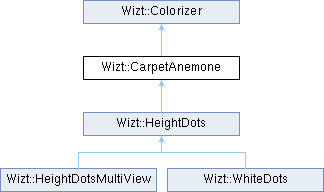
The CarpetAnemone handles a colormap attached to an Anemone. More...
#include <CarpetAnemone.hpp>
Classes | |
| struct | ColormapTexture |
| A ColormapTexture object is an interface that allows to remember a set of textures. More... | |
Public Types | |
| template<class T, int EL = VSlotContainer::InvalidExpertLevel> | |
| using | in_t = VObject::in<T, EL> |
Public Member Functions | |
| CarpetAnemone (VObject *that, const string &slotname="colormap", int EL=0) | |
| std::string | scalarfield_vertex_shader (VRenderContext &Context) const |
| Public Member Functions inherited from Wizt::Colorizer | |
| Colorizer (VObject *that, const string &slotname="colormap", int EL=0) | |
| MemCore::RefPtr< RenderBasin::TextureTentacle > | createColormapTexture (VRenderContext &Context, int TextureUnit, const MemCore::RefPtr< RenderBasin::TextureTentacle > &OldTT=NullPtr(), bool IntegerTexture=false) const |
| bool | haveNewerColormap (VRenderContext &Context, const Ageable &) const |
| MemCore::RefPtr< RenderBasin::TextureTentacle > | makeColormapTexture (VRenderContext &Context, const RefPtr< RenderBasin::Program > &ShaderProgram, int TextureUnit, const string &ShaderTexturename="", bool IntegerTexture=false) const |
Static Public Member Functions | |
| static RefPtr< RenderBasin::TextureTentacle > | getColormapTexture (const GridAnemone::AnemoneCreationContext &ACC, int TextureUnit) |
| static void | setupRangeFromBoundingBoxHeight (const string &HeightRangeShaderVariableName, Anemone &RenderAnemone, const VObject::in< Range > &inHeightRange, VRenderContext &theRenderContext, std::function< RefPtr< Fiber::DataRangeBase >(VRenderContext &)>Ranger=nullptr) |
| In the shader code the color map will be accessible under the name that we define here. | |
| static void | setupRangeFromBoundingBoxHeight (const string &HeightRangeShaderVariableName, Anemone &RenderAnemone, const VObject::in< Range > &inHeightRange, const GridAnemone::AnemoneCreationContext &ARC, std::function< RefPtr< Fiber::DataRangeBase >(VRenderContext &)>Ranger=nullptr) |
| Static Public Member Functions inherited from Wizt::Colorizer | |
| static RefPtr< RenderBasin::TextureTentacle > | createColormapTexture (Colormap &Cmap, VRenderContext &Context, int TextureUnit, const MemCore::RefPtr< RenderBasin::TextureTentacle > &OldTT=nullptr, bool IntegerTexture=false) |
| static const char * | getColormapFunctionDefinitions () |
| static bool | setSmoothColormap (const MemCore::RefPtr< RenderBasin::TextureTentacle > &TT, bool yes=true) |
Public Attributes | |
| VObject::in< bool > | inUseLocalBoundingBoxForHeightRange |
Detailed Description
The CarpetAnemone handles a colormap attached to an Anemone.
Carpet anemones: Beautiful, fragile, and deadly
Anemones of the genus Stichodactyla are some of the most colorful inverts in the sea, but they're also notoriously poor shippers, and those that do survive their trek from sea to aquarium can turn out to be deadly additions to your reef. Leonard Ho http://www.advancedaquarist.com/blog/carpet-anemones-beautiful-but-deadly
To check whether the colormap has changed and the render Anemone needs to be updated, use code like this (note that updating just the colormap instead of re-creating the Anemone yet has to be implemented - 12SEP14):
Optionally, an additional colormap input slot can be checked by specifying this slot:
To use and possibly create a default color map, override the setup() function in a derived class an implement like this:
Member Function Documentation
◆ setupRangeFromBoundingBoxHeight()
|
static |
In the shader code the color map will be accessible under the name that we define here.
In the GLSL code it will then be named as
and can be accessed via
Generated by
 1.16.1