The Grid Atlas contains the set of all charts which are defined on a Grid object. More...
#include <Atlas.hpp>
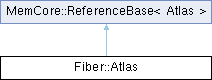
Classes | |
| struct | Globals |
Public Types | |
| typedef set< RefPtr< Chart > > | Atlas_t |
| using | Transformators = unordered_set<WeakPtr<Transformator>> |
| using | TransformationsIntoNamedChart = std::unordered_map<string, RefPtr<Transformation>> |
| using | TransformationsByName = std::unordered_map<string, TransformationsIntoNamedChart> |
| Public Types inherited from Wizt::ReferenceBase< Atlas > | |
| typedef Object | reference_domain_t |
| typedef WeakPtr< Object, Object > | SelfPtr_t |
Public Member Functions | |
| Atlas (const RefPtr< GlobalCharts > &GA) | |
| const RefPtr< GlobalCharts > & | getGlobalAtlas () const |
| RefPtr< ChartIDList > | operator() (const type_info &ti) const |
| Given a certain type id of a chart, return a list of possible chart identifiers that are globally associated with this chart. | |
| ChartIDList & | operator[] (const type_info &) |
| Given a certain type id of a chart, return a container with chart identifiers. | |
| RefPtr< ChartID > | mkChartID (const type_info &ti, const string &name) |
| Make a chart Identifier for a given coordinate type and text. | |
| RefPtr< ChartID > | mkChartID (const type_info &ti, const string &name, uint16_t epsg_code) |
| void | insertChart (const RefPtr< Chart > &newChart) |
| bool | insertSharedChart (const RefPtr< Chart > &ExistingChart) |
| RefPtr< Chart > | operator() (const RefPtr< ChartID > &) const |
| Search for a certain chart by name. | |
| RefPtr< Chart > | operator() (unsigned epsg_code) const |
| Search for a chart by EPSG Code. | |
| RefPtr< Chart > | operator() (const RefPtr< Chart > &C) const |
| Search for a compatible chart. | |
| RefPtr< Transformation > | getTransformation (const Chart &DestinationChart, const Chart &SourceChart) const |
| Check whether a global default chart exits for the given domain The name of such a default chart is generated from the name of the type info, prefixed with "Standard". | |
| std::tuple< RefPtr< Atlas >, RefPtr< Chart > > | getTransformation (const Chart &DestinationChart) const |
| Public Member Functions inherited from Wizt::ReferenceBase< Atlas > | |
| auto | getObjectCountID () const noexcept |
| bool | isIdentical (const WeakPtr< Object, Object > &PossibleSelf) const noexcept |
| void | mkAutoDestructive () |
| refcount_t | refcount () const noexcept |
| ReferenceBase (Object *that) noexcept | |
| const auto & | self () const |
| refcount_t | wrefcount () const noexcept |
Static Public Member Functions | |
| static Globals & | myGlobals () |
| static TransformationsByName & | GlobalTransformations () |
| static Transformators & | GlobalTransformators () |
| static RefPtr< Transformation > | getGlobalTransformation (const Chart &DestinationChart, const Chart &SourceChart) |
Public Attributes | |
| Atlas_t | ChartSet |
| RefPtr< GlobalCharts > | GlobalAtlas |
| TransformationsByName | LocalTransformations |
Friends | |
| RefPtr< Transformation > | operator>> (const std::tuple< RefPtr< Atlas >, RefPtr< Chart > > &L, const Chart &SourceChart) |
Additional Inherited Members | |
| Protected Member Functions inherited from Wizt::ReferenceBase< Atlas > | |
| virtual void | extremeUnction () |
| ReferenceBase & | operator= (const ReferenceBase &R) |
| void | suicide () |
Detailed Description
The Grid Atlas contains the set of all charts which are defined on a Grid object.
The functional purpose of the GridAtlas is to allocate and manage local and global charts: When data are stored in a Representation, they need to be associated with a chart object. Interpolation between two Representation objects is only allowed if their both charts ("representers") are identical. Otherwise, they might still refer to the same ChartID. In general, global charts should be used, i.e. the same chart object for all Grid objects, such that data interpolation is possible. Only in certain case local charts are required to disallow data interpolation; an example is a non-commutative data generation rule, e.g. when another operation than coordinate transformation is required.
Member Function Documentation
◆ getTransformation()
| RefPtr< Transformation > Fiber::Atlas::getTransformation | ( | const Chart & | DestinationChart, |
| const Chart & | SourceChart ) const |
Check whether a global default chart exits for the given domain The name of such a default chart is generated from the name of the type info, prefixed with "Standard".
Return a global default chart for the given domain. The name of such a default chart is generated from the name of the type info, prefixed with "Standard". Return a global, arbitarily named chart for the given domain.
References std::unordered_map< typename _Key, typename _Tp, typename _Hash, typename _Pred, typename _Alloc >::end(), std::unordered_map< typename _Key, typename _Tp, typename _Hash, typename _Pred, typename _Alloc >::find(), getTransformation(), and Fiber::Chart::Name().
Referenced by getTransformation().
◆ mkChartID()
Make a chart Identifier for a given coordinate type and text.
The chart identifier is automatically registered with the GlobalAtlas.
Generated by
 1.16.1