Explanation of buffer residency and upload strategy on drivers where persistent/coherent mappings are backed by host-visible system memory. More...
#include <ocean/GLvish/VertexArrayObject.hpp>
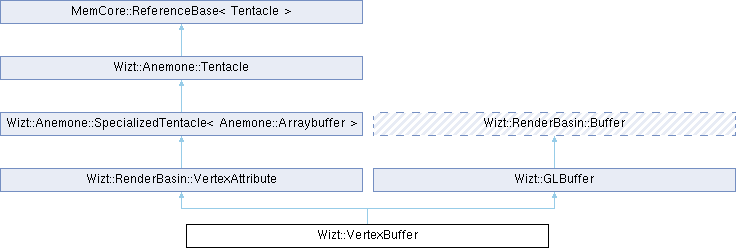
Public Member Functions | |
| bool | activate (const Anemone &) override |
| Activate this tentacle. | |
| bool | deactivate (const Anemone &) override |
| Deactivate this tentacle. | |
| size_t | memsize () const override |
| Return the memory occupied by this buffer if it occupies memory at all. Otherwise, returns 0 (default). | |
| size_t | NumberOfElements () const override |
| Returns the number of elements provided and used by this object, if it refers to countable elements. | |
| bool | updateValue (VRenderContext &Context) override |
| Possibly update a tentacle from settings in a context. | |
| Public Member Functions inherited from Wizt::Anemone::Tentacle | |
| virtual const char * | getSamplerType () const |
| If this tentacle refers to some texture sampler in a shader, then hereby return the type of this sampler is it occurs in the code. | |
| virtual int | getTextureUnit () const |
| Get the texture unit number which was specified during construction, if positive then it refers to some texture unit that is used in an associated shader. | |
| Public Member Functions inherited from MemCore::ReferenceBase< Tentacle > | |
| auto | getObjectCountID () const noexcept |
| Get a unique ID for this object in the given domain. | |
| bool | isIdentical (const WeakPtr< Tentacle, Tentacle > &PossibleSelf) const noexcept |
| Check if this object is identical to the one used by the given pointer. | |
| void | mkAutoDestructive () |
| Marks this object as being automatically destructed, e.g. | |
| refcount_t | refcount () const noexcept |
| The strong reference count. | |
| ReferenceBase (Tentacle *that) noexcept | |
| Constructor, initializes reference counter to zero. | |
| const auto & | self () const |
| Return weak pointer to the object self. | |
| refcount_t | wrefcount () const noexcept |
| The weak reference count. | |
| Public Member Functions inherited from Wizt::GLBuffer | |
| void * | map_wo (size_t offset=0, size_t length=0) const override |
| Recommended creation and usage pattern for a short-lived CPU staging buffer. | |
| void | setSubData (size_t offset, const void *data, size_t length) const override |
| Set a subset of the data, which is more efficient than setData();. | |
| Public Member Functions inherited from Wizt::MapMemory | |
| void | setData (size_t length, const StorageFlags &SF) const |
| Reserve data only. | |
Additional Inherited Members | |
| Public Types inherited from MemCore::ReferenceBase< Tentacle > | |
| using | reference_domain_t |
| The type of the base class. | |
| using | SelfPtr_t |
| Type for a pointer to this object itself. | |
| Public Attributes inherited from Wizt::RenderBasin::VertexAttribute | |
| unsigned | DoublePrecision:1 |
| Load data in double precision. | |
| unsigned | Integer:1 |
| Hint whether the attribute is an integer data type in the shader, in which case it will be loaded differently. | |
| unsigned | Normalized:1 |
| Indicate whether this buffer will be normalized to the range [0,1] if it is an integer type loaded to a floating point attribute. | |
| unsigned | Signed:1 |
| Indicate if this integer type is signed. | |
| Public Attributes inherited from Wizt::Anemone::Tentacle | |
| Activity_t | Activity |
| A bit mask telling whether this tentacle should participate in the waving of an Anemone. | |
| Protected Member Functions inherited from MemCore::ReferenceBase< Tentacle > | |
| virtual void | extremeUnction () |
| A virtual function that will be called just before the object is destroyed. | |
| ReferenceBase & | operator= (const ReferenceBase &R) |
| Protected assignment operator (should not be called). | |
| void | suicide () |
| Delete this. | |
| virtual | ~ReferenceBase () |
| Virtual destructor. | |
Detailed Description
Explanation of buffer residency and upload strategy on drivers where persistent/coherent mappings are backed by host-visible system memory.
This document describes the observed behavior of buffer allocations created with glNamedBufferStorage() using the flags GL_MAP_WRITE_BIT | GL_MAP_PERSISTENT_BIT | GL_MAP_COHERENT_BIT, and the resulting requirement to use a staging buffer followed by an explicit GPU-side copy operation to obtain device-local (VRAM) storage.
Persistent Mapped Buffers
Buffers created with:
and subsequently mapped via:
are allocated in host-visible memory on the tested driver. This memory region is CPU-accessible and suitable for direct writes, but it is not device-local VRAM. GPU access to this memory is significantly slower than access to device-local storage.
This behavior is compliant with the OpenGL specification. The specification does not mandate that persistent/coherent mappings must refer to device-local memory; the driver may place such buffers in any memory region that satisfies the required mapping properties.
Device-Local Buffers
Buffers created without any mapping-related flags:
are allocated in device-local VRAM on the tested driver. These buffers are not mappable by the CPU and provide optimal access performance for GPU read operations (e.g., vertex fetch).
Required Upload Path
Because persistent mapped buffers reside in host-visible memory and not in device-local VRAM, rendering directly from such buffers results in reduced GPU performance. To obtain device-local storage, a two-step upload process is required:
- Allocate a host-visible staging buffer using persistent/coherent mapping flags and write data into it via the mapped pointer.
- Allocate a device-local buffer without mapping flags.
- Transfer the data from the staging buffer to the device-local buffer using: glCopyNamedBufferSubData(stagingBuffer, deviceLocalBuffer, srcOffset,dstOffset, size);
The resulting device-local buffer can then be used for rendering with optimal performance.
Synchronization
The completion of the GPU-side copy operation must be synchronized before the device-local buffer is used for rendering. This is typically achieved using glFenceSync() and glClientWaitSync() or equivalent synchronization mechanisms. However, fences are not resource-aware and cannot be used to check the status of a VertexArrayObject .
Summary
- Persistent/coherent mapped buffers are host-visible and not device-local on the tested driver.
- Device-local VRAM buffers must be created without mapping flags.
- A staging-buffer-plus-copy upload path is required for high-performance static geometry.
- Synchronization is required to ensure copy completion before rendering.
Member Function Documentation
◆ NumberOfElements()
|
overridevirtual |
Returns the number of elements provided and used by this object, if it refers to countable elements.
Otherwise, returns 0 (default).
Reimplemented from Wizt::Anemone::Tentacle.
References NumberOfElements().
Referenced by NumberOfElements().
◆ updateValue()
|
overridevirtual |
Possibly update a tentacle from settings in a context.
- Returns
- true if it was successful, false if it could not be done and the tentacle might need to be re-created.
Reimplemented from Wizt::Anemone::Tentacle.
References updateValue().
Referenced by updateValue().
Generated on for The Vish Visualization Shell by
 1.16.1