Base class for objects that can render to multiple views at once, such as needed for single-pass stereo rendering. More...
#include <ocean/Anemonia/MultiView.hpp>
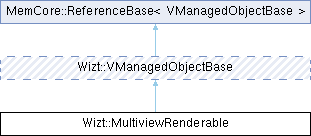
Public Member Functions | |
| bool | exception_safe_multiview_render (const RefPtr< RenderAble > &that, double &RenderTime, VRenderContext &Context, const VRenderContext::MultiView &Eyes, RenderAble::SubContext &SC) noexcept |
| Calls multiview_render() and handles possible exceptions. | |
| virtual bool | multiview_render (VRenderContext &Context, const MultiView &Eyes, RenderAble::SubContext &SC)=0 |
| The multiview_render() function allows render objects to handle stereo, or multiview rendering in general. | |
| Public Member Functions inherited from Wizt::VManagedObjectBase | |
| VManagedObjectBase () | |
| Constructor. | |
| ~VManagedObjectBase () | |
| Destructor. | |
| Public Member Functions inherited from MemCore::ReferenceBase< VManagedObjectBase > | |
| auto | getObjectCountID () const noexcept |
| Get a unique ID for this object in the given domain. | |
| bool | isIdentical (const WeakPtr< VManagedObjectBase, VManagedObjectBase > &PossibleSelf) const noexcept |
| Check if this object is identical to the one used by the given pointer. | |
| void | mkAutoDestructive () |
| Marks this object as being automatically destructed, e.g. | |
| refcount_t | refcount () const noexcept |
| The strong reference count. | |
| ReferenceBase (VManagedObjectBase *that) noexcept | |
| Constructor, initializes reference counter to zero. | |
| const auto & | self () const |
| Return weak pointer to the object self. | |
| refcount_t | wrefcount () const noexcept |
| The weak reference count. | |
Additional Inherited Members | |
| Public Types inherited from MemCore::ReferenceBase< VManagedObjectBase > | |
| using | reference_domain_t |
| The type of the base class. | |
| using | SelfPtr_t |
| Type for a pointer to this object itself. | |
| Protected Member Functions inherited from MemCore::ReferenceBase< VManagedObjectBase > | |
| virtual void | extremeUnction () |
| A virtual function that will be called just before the object is destroyed. | |
| ReferenceBase & | operator= (const ReferenceBase &R) |
| Protected assignment operator (should not be called). | |
| void | suicide () |
| Delete this. | |
| virtual | ~ReferenceBase () |
| Virtual destructor. | |
Detailed Description
Base class for objects that can render to multiple views at once, such as needed for single-pass stereo rendering.
The implementation is based on the OVR multiview extension https://registry.khronos.org/OpenGL/extensions/OVR/OVR_multiview.txt and called in with OVR multiview being enabled during the virtual multiview_render function.
Example code for a vertex shader:
Member Function Documentation
◆ multiview_render()
|
pure virtual |
The multiview_render() function allows render objects to handle stereo, or multiview rendering in general.
It has access to all the view parameters at once, the "Eyes". The default code just iterates over all eyes, "opens" each eye in the given Context, and calls the appropriate render() function (the one with a SubContext) then:
Instead, some stereo-capable code may access both stereo buffers directly to perform immediate rendering.
References exception_safe_multiview_render().
Referenced by exception_safe_multiview_render().
Generated on for The Vish Visualization Shell by
 1.16.1