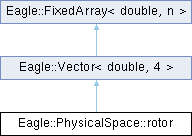
A rotor is the sum of scalar with a bivector. More...
#include <elementary/eagle/rotor3.hpp>
Public Member Functions | |
| bivector & | bivec () |
| Retrieve bivector component, read-only. | |
| const bivector & | bivec () const |
| Retrieve bivector component, read-only. | |
| rotor | conj () const |
| Compute the conjugate rotor. | |
| rotor | inv () const |
| Compute the inverse rotor. | |
| bivector | operator() (const bivector &V) const |
| Rotate a bivector. | |
| vector | operator() (const vector &v) const |
| The sandwich product: Compute Rv ~R, which is the rotation of the vector v by the current rotor. | |
| OddMultiVector | operator* () const |
| Applying the hodge star operator. | |
| rotor () | |
| Default constructor. | |
| rotor (const bivector &b, double r) | |
| Construct rotor from bivector and scalar. | |
| rotor (const double s) | |
| Create rotor with just scalar component, bivector is zero. | |
| rotor (const rotor &b) | |
| Copy constructor. | |
| rotor (const rotor &b, const Operator<'~'> &) | |
| Computational constructor computing the conjugate (inverse) rotor. | |
| rotor (const Vector< double, 4 > &V) | |
| Explicit construction from double. | |
| rotor (double r, const bivector &b) | |
| Construct rotor from scalar and bivector. | |
| rotor (double r, double b1, double b2, double b3) | |
| Construct rotor from four doubles. | |
| double & | scalar () |
| Retrieve scalar component, modifyable. | |
| double | scalar () const |
| Retrieve scalar component, read-only. | |
| rotor | unit () const |
| Normalize to a unit rotor (added by mr). | |
| Public Member Functions inherited from Eagle::Vector< double, 4 > | |
| Base_t & | fixed_array () |
| Provide access to the base class, writable. | |
| Vector & | operator*= (const double &value) |
| Self-multiplication. | |
| Vector & | operator+= (const Vector &v) |
| Self-addition. | |
| Vector & | operator-= (const Vector &v) |
| Self-subtraction. | |
| Vector & | operator/= (const double &value) |
| Self-division. | |
| Vector & | operator= (const Vector &src) |
| Assignment operator. | |
| void | set (const V &value) |
| Assign all values to the same scalar. | |
| constexpr | Vector () |
| Default constructor. | |
| Public Member Functions inherited from Eagle::FixedArray< double, n > | |
| void | expandMinMax (FixedArray &MinValues, FixedArray &MaxValues) const |
| Expand a range given by MinValues,MaxValues to include the values of this array, done per component. | |
| constexpr | FixedArray () noexcept |
| Default constructor. | |
| constexpr double & | get (int i) |
| writable element access | |
| constexpr const FixedArray< double, subsize > * | get_subarray () const |
| Helper class for retrieve a subset of the current array. | |
| constexpr const FixedArray< double, SIZE-1 > & | get_subdim () const |
| Mainly introduced because of Interpolate::operator[]. | |
| const FixedArray_t & | getFixedArray () const noexcept |
| convenience function for base classes | |
| constexpr double | getMax () const |
| Compute the maximum element value of this array. | |
| constexpr double | getMin () const |
| Compute the maximum element value of this array. | |
| constexpr bool | operator!= (const FixedArray< T, N > &F) const |
| Compare two arrays. | |
| constexpr bool | operator== (const FixedArray< T, N > &F) const |
| Compare two arrays. | |
| constexpr double & | operator[] (int i) |
| writeable element access operator | |
| constexpr double * | ptr (int i=0) noexcept |
| Return a pointer to the ith element, no range checking. | |
| constexpr void | set (const Value &x) |
| Set all array elements to the same value. | |
| void | setFromArray (const double *x, int length=SIZE, int offset=0) |
| Set all array elements to an array's element value. | |
| void | sort (FixedArray< int, N > &I) const |
| Sort the elements of an array into the index array. | |
Friends | |
| eagle_API rotor | operator* (const rotor &l, const rotor &r) |
| Multiply rotors, which is a concatenation operation of rotations. | |
| OddMultiVector | operator* (const rotor &R, const vector &v) |
| Multiply rotor and vector, yielding an odd multivector, the dual of a rotor. | |
| bivector & | operator*= (bivector &V, const rotor &R) |
| Rotate a certain bivector by a rotor "in place". | |
| vector & | operator*= (vector &v, const rotor &R) |
| Rotate a certain vector by a rotor "in place". | |
Related Symbols | |
(Note that these are not member symbols.) | |
| rotor | exp (const bivector &i) |
| Compute the exponential of a bivector, which implements a rotation as given by the norm of the bivector. | |
| rotor | exp (const bivector &U, double phi) |
| Implement a rotation of phi degrees along the bivector U. | |
| rotor | exp (const rotor &s) |
| Compute the exponential of a rotor (by Andrew Hamilton). | |
| rotor | ln (const rotor &s) |
| Compute the natural logarithm of a rotor (by Andrew Hamilton). | |
| vector | operator% (const vector &l, const vector &r) |
| Compute the three-dimensional cross product. | |
| bivector | operator() (const bivector &V) const |
| Rotate a bivector. | |
| rotor | operator* (const vector &l, const vector &r) |
The multiplication operation on two vectors implements the geometric product  | |
| rotor | operator+ (const bivector &U, double r) |
| Create a rotor as sum of bi-vector and scalar. | |
| rotor | operator+ (const rotor &U, double r) |
| Add a scalar value to a rotor. | |
| rotor | operator+ (double r, const bivector &U) |
| Create a rotor as sum of scalar and bi-vector. | |
| rotor | operator+ (double r, const rotor &U) |
| Add a scalar value to a rotor. | |
| rotor | operator- (const rotor &U, double r) |
| Add a scalar value to a rotor. | |
| rotor | operator- (double r, const bivector &U) |
| Create a rotor as difference of scalar and bi-vector. | |
| rotor | operator- (double r, const rotor &U) |
| Add a scalar value to a rotor. | |
| rotor | operator/ (const rotor &l, const rotor &r) |
Note that  | |
| rotor | operator/ (const vector &l, const vector &r) |
| Divide two vectors, yielding the rotation operation to sweep the second vector to the first one. | |
| rotor | operator~ (const rotor &r) |
| Compute the inverse rotor. | |
| rotor | pow (const rotor &r, double t) |
| Compute the power of a rotor. | |
| Matrix< 4, 4, double > | rotmatrix (const rotor &r) |
| Compute the classical 4x4 rotation Matrix. | |
| rotor | slerp (const rotor &r1, const rotor &r2, double t) |
| Interpolate between q1 (t = 0) and q2 (t = 1): q = (q2/q1)^t q1 . | |
Additional Inherited Members | |
| Public Types inherited from Eagle::Vector< double, 4 > | |
| enum | |
| The number of elements in this array. | |
| Public Types inherited from Eagle::FixedArray< double, n > | |
| typedef FlattenedArray_t::value_type | Element_t |
| The maximally reduced type of elements stored here. | |
| typedef GetFixedArrayType< double >::result_t | ElementAsFixedArray_t |
| Element type as fixed array, if it is convertible to a fixed array. | |
| typedef FixedArray | FixedArray_t |
| Exporting the type definition of this array cass type. | |
| typedef FixedArrayFlattener< FixedArrayOfElements_t > | FixedArrayFlattener_t |
| Internal helper class. | |
| typedef FixedArray< ElementAsFixedArray_t, N > | FixedArrayOfElements_t |
| If the value is derived from a fixed array type itself, then the FixedArrayOfElements_t is an FixedArray<FixedArray<>> type. | |
| typedef FixedArrayFlattener_t::result_t | FlattenedArray_t |
| Reduction of this array type, if it is nested, to an flattened type which contains elementary types. | |
| typedef double | value_type |
| Export the type of the respective element value type. | |
| Static Public Member Functions inherited from Eagle::FixedArray< double, n > | |
| static constexpr FixedArray | convert (const FixedArray< T, N > &F, const ConversionFunctor &CF) |
| Perform a type conversion on a given fixed array into another basis type: | |
| static constexpr dimension_t | size () |
| The number of elements here. | |
| Protected Attributes inherited from Eagle::FixedArray< double, n > | |
| double | data [SIZE] |
| The actual data values, intentional no-initialization for data member, which increases performance on vector creation. | |
Detailed Description
A rotor is the sum of scalar with a bivector.
It represents the even subalgebra (for instance grade 0 and 2) of the geometric algebra of euclidean 3-space and implements the same algebraic properties as a Pauli spinor. There are 3+1 components in a rotor in 3-space.
To use a rotor to rotate a vector v around a bivector u look at rotor::operator()
- Todo
- Need to implement optimization for unit rotors, such that the norm2() function always returns 1.0 without computation.
Member Function Documentation
◆ operator()()
The sandwich product: Compute Rv ~R, which is the rotation of the vector v by the current rotor.
R(v) = R v ~R = (s+U) v (s-U) = (s v + U v) (s-U) = s v s + U v s - s v U - U v U = s s v + Uv s - s vU - U(v) = ss v + 2 Uv s - U(v).
To rotate a vector v with angle phi around a bivector u you may use:
- Todo
- Hmm, isn't there a sign error in the 2 s vU part? Plz verify!!
References bivec(), Eagle::PhysicalSpace::dot(), and scalar().
Friends And Related Symbol Documentation
◆ exp()
Implement a rotation of phi degrees along the bivector U.
If U is not unit, then the resulting rotor will also scale a given vector.
- Parameters
-
phi Rotation in radians.
References rotor().
◆ ln()
Compute the natural logarithm of a rotor (by Andrew Hamilton).
References bivec(), Eagle::norm2(), rotor(), and unit().
◆ operator()()
Rotate a bivector.
This operator is equivalent to 
- Note
- Let's hope the compiler optimizes this function sufficiently.
◆ operator* [1/2]
|
friend |
Multiply rotor and vector, yielding an odd multivector, the dual of a rotor.
Use its vec() member function to retrieve the vectorial part.
References rotor().
◆ operator*() [2/2]
The multiplication operation on two vectors implements the geometric product
Geometrically it means the operation to sweep one vector r to a vector l, which results in a rotor.
References Eagle::PhysicalSpace::dot(), and rotor().
◆ operator*=
Rotate a certain bivector by a rotor "in place".
- Note
- This is numerically not more efficient than assignment.
References rotor().
◆ operator/()
Divide two vectors, yielding the rotation operation to sweep the second vector to the first one.
This operation is identical to (l r^-1).
References Eagle::PhysicalSpace::vector::inv(), and rotor().
◆ operator~()
◆ rotmatrix()
Compute the classical 4x4 rotation Matrix.
E.g. for use with openGls: glMultMatrixd like: glMultMatrixd( RotMat.ptr() );
References Eagle::Matrix< R, C, Value >::column(), and rotor().
Generated on for The Vish Visualization Shell by
 1.16.1