Intermediate class managing VSlots. More...
#include <ocean/plankton/VSlotContainer.hpp>
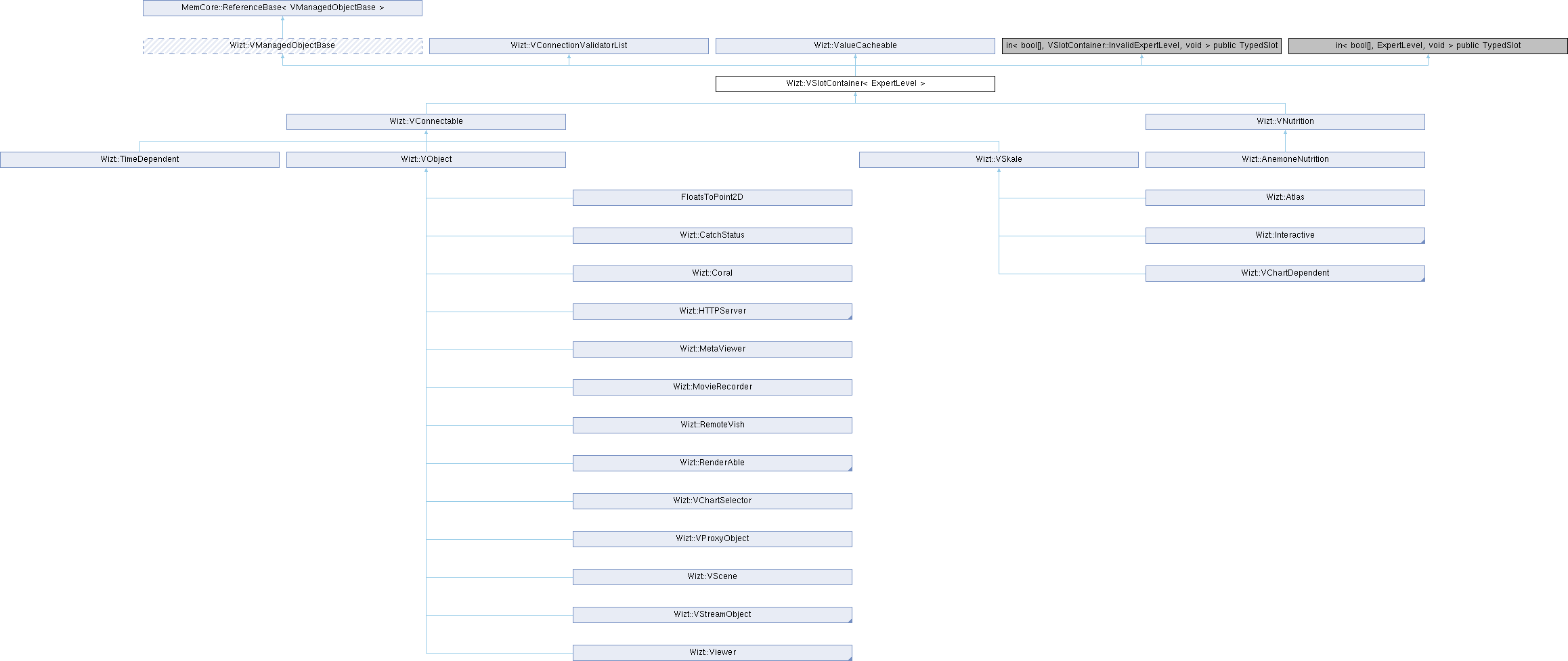
Classes | |
| struct | Deferred |
| Internal helper class used for the construction of VOutput objects. More... | |
| struct | in |
| Input types. More... | |
| struct | in< bool[], ExpertLevel, void > |
| struct | in< bool[], VSlotContainer::InvalidExpertLevel, void > |
| struct | in< Type, ExpertLevel, void > |
| struct | in< Type, VSlotContainer::InvalidExpertLevel, void > |
| struct | inout |
| Input types that are also visible as outputs, i.e. More... | |
| struct | inout< Type, void > |
| struct | out |
| Output types. More... | |
| struct | out< Type, void > |
| class | VInputSet |
Public Types | |
| enum | { AllLevels = INT_MAX } |
| typedef void | AcceptableInputTypes |
| Each VObject may define a set of possible input types, which are types that are provided by some other objects to be used as inputs of this object. | |
| typedef VSlotSet | CreationSlots_t |
| A set of slots. | |
| template<int I> | |
| using | Empty = VSlot::Empty<I> |
| Shortcut typedef to be used in construction of empty slots. | |
| Public Types inherited from MemCore::ReferenceBase< VManagedObjectBase > | |
| using | reference_domain_t |
| The type of the base class. | |
| using | SelfPtr_t |
| Type for a pointer to this object itself. | |
Public Member Functions | |
| Ageable & | age (const RefPtr< ValuePool > &VP) |
| Return the age of this object, which may be modified. | |
| const Ageable & | age (const RefPtr< ValuePool > &VP) const |
| Return the age of this object in read-only form. | |
| const Ageable & | ConnectionAge () const |
| Return the age when connections had last been modified. | |
| bool | ConnectionsHaveChanged (const RefPtr< ValuePool > &VP) const |
| Check whether the connections have changed on this object. | |
| bool | HasYoungerInput (const RefPtr< ValuePool > &Context, int RecursionLevel=0) const |
| Ageable | YoungestInput (const RefPtr< ValuePool > &Context) const |
| Return the age of the youngest input. | |
| Ageable | YoungestOutput (const RefPtr< ValuePool > &Context) const |
| Determine the age of the youngest output object. | |
| Ageable | YoungestUncachedInput (const RefPtr< ValuePool > &Context) const |
| Return the age of the youngest input slot that is not cached. | |
| virtual | ~VSlotContainer () |
| Destructor. | |
| Public Member Functions inherited from Wizt::VManagedObjectBase | |
| VManagedObjectBase () | |
| Constructor. | |
| ~VManagedObjectBase () | |
| Destructor. | |
| Public Member Functions inherited from MemCore::ReferenceBase< VManagedObjectBase > | |
| auto | getObjectCountID () const noexcept |
| Get a unique ID for this object in the given domain. | |
| bool | isIdentical (const WeakPtr< VManagedObjectBase, VManagedObjectBase > &PossibleSelf) const noexcept |
| Check if this object is identical to the one used by the given pointer. | |
| void | mkAutoDestructive () |
| Marks this object as being automatically destructed, e.g. | |
| refcount_t | refcount () const noexcept |
| The strong reference count. | |
| ReferenceBase (VManagedObjectBase *that) noexcept | |
| Constructor, initializes reference counter to zero. | |
| const auto & | self () const |
| Return weak pointer to the object self. | |
| refcount_t | wrefcount () const noexcept |
| The weak reference count. | |
Protected Member Functions | |
| virtual void | setup (const CreationSlots_t &CreationSlots) |
| When a VObject is created as a child of an existing VObject, this variant of the setup function is called, telling which slot is the one connected to the object that triggered creation of this one. | |
| Protected Member Functions inherited from MemCore::ReferenceBase< VManagedObjectBase > | |
| virtual void | extremeUnction () |
| A virtual function that will be called just before the object is destroyed. | |
| ReferenceBase & | operator= (const ReferenceBase &R) |
| Protected assignment operator (should not be called). | |
| void | suicide () |
| Delete this. | |
| virtual | ~ReferenceBase () |
| Virtual destructor. | |
Related Symbols | |
(Note that these are not member symbols.) | |
| bool | CheckIfThereExistNewerOutputs (const VRequest &request, bool AdjustObjectAge) const |
| Check if there are outputs in this very object that are newer (more recent) than this object itself. | |
Functions related to input parameters | |
| enum | AttachErrorCode { } |
| RefPtr< VSlot > | addParameter (const ParameterID &name, int EL, const RefPtr< VParameter > ¶m, bool overwriteExistingSlot) |
| Specify a parameter (type) as input for this VObject. | |
| virtual bool | allowParameterReplacement (const RefPtr< VParameter > &NewParam, const RefPtr< VParameter > &OldParam, const string &localName, int ExpertLevel) |
| Virtual callback function invoked by replaceParameter() when the implementation of a parameter is changed by another one. | |
| virtual int | connectSlots (const VSlotContainerPtr &vobj) |
| Tries to connect all slots found in the given VObject with those of the current one. | |
| bool | removeParameter (const ParameterID &s) |
| Remove a parameter from the list of input objects. | |
| RefPtr< VParameter > | getParameter (const ParameterID &s) const |
| Return the local input parameter slot for a certain parameter name. | |
| RefPtr< VSlot > | getSlot (const ParameterID &s, int &EL) const |
| A more verbose version of getParameter() which also provides information about which member of a certain parameter is used here; note that the type of the full parameter will be different from the type of a member of the parameter. | |
| bool | setSlotValueFromText (const ParameterID &s, const string &ValueText, const RefPtr< ValuePool > &VP, const string &theMember={}) |
| Convenience function to set an input value from its textual representation. | |
| RefPtr< VSlot > | findSlot (const RefPtr< VParameter > ¶m) const |
| Given a parameter, find a slot that refers to this one. | |
| string | getSlotName (const RefPtr< VParameter > ¶m) const |
| Check whether this object contains the given parameter, and if so, under which slot's name. | |
| bool | AddAction (const ParameterID &s, const RefPtr< ValueActionBase > &VAB) |
| Associate the change of a certain parameter of this object with a certain action. | |
| template<class DerivedObject> | |
| bool | AddAction (const RefPtr< VSlot > &ActionSlot, bool(DerivedObject::*Action)(const RefPtr< VValueBase > &value)) |
| Connect the change of a parameter with the invocation of an object's member function. | |
| RefPtr< VParameter > | mkUniqueParameterInput (const ParameterID &s, const string &ContainerName) |
| Calls VParameter::copy();. | |
| int | getExpertLevel (const ParameterID &s) const |
| Get the expert level of a parameter. | |
| int | setExpertLevel (const ParameterID &s, int EL) |
| Set the expert level of a parameter. | |
| int | getExpertLevel (const RefPtr< VParameter > &) const |
| Get the expert level of a parameter via pointer. | |
| int | getExpertLevel (const RefPtr< VSlot > &S) const |
| Get the expert level of a parameter via pointer. | |
| int | setExpertLevel (const RefPtr< VSlot > &S, int EL) |
| Set the expert level of a parameter via pointer. | |
| int | setExpertLevel (const RefPtr< VParameter > &s, int EL) |
| Set the expert level of a parameter via pointer. | |
| bool | hasChanged (const ParameterID &s, const RefPtr< ValuePool > &Context) const |
| Check whether a certain input parameter has changed. | |
| bool | hasChanged (const RefPtr< VSlot > &, const RefPtr< ValuePool > &Context) const |
| Check whether a certain input slot has changed. | |
| bool | hasChanged (const RefPtr< ValuePool > &Context, int n,...) const |
| Check a set of input parameters whether one has changed. | |
| bool | hasChanged (RefPtr< ValuePool > Context,...) const |
| Check a set of input parameters whether one has changed. | |
| virtual bool | ignoreInput (const RefPtr< VSlot > &theSlot) const |
| Allow ignoring certain slots on update(). | |
| template<class Type> | |
| bool | getParameterValue (Type &Variable, const ParameterID &s, const RefPtr< ValuePool > &VP) const |
| Get a value for a certain parameter. | |
| template<class Type> | |
| bool | getParameterValue (Type &Variable, const ParameterID &s, const VContext &C) const |
| Get a value for a certain parameter. | |
| template<class Type> | |
| bool | getParameterValue (Type &Variable, const ParameterID &s, const VRequest &R) const |
| Get a value for a certain parameter. | |
| template<class Type> | |
| bool | setParameterValue (const Type &Variable, const ParameterID &s, const RefPtr< ValuePool > &VP, bool autoCreateLocalValue) const |
| Set a value for a parameter, given a ValuePool. | |
| template<class Type> | |
| bool | setParameterValue (const Type &Variable, const ParameterID &s, VContext &C, bool autoCreateLocalValue) const |
| Set a value for a parameter, given a context. | |
| template<class Type> | |
| bool | setParameterValue (const Type &Variable, const ParameterID &s, VRequest &R, bool autoCreateLocalValue=false) const |
| Set a value for a parameter, given a context. | |
| template<class Type> | |
| RefPtr< VSlot > | addParam (const ParameterID &name, const Type &init, const RefPtr< VCreationPreferences > &VP=NullPtr(), int expertLevel=0, bool overwriteExistingSlot=true) |
| Add an input parameter to the VObject. | |
| bool | setParameterProperty (const ParameterID ¶m, const string &Properties, const RefPtr< VValueBase > &Value=NullPtr()) |
| Set a property of an input parameter, such as the minimum or maximum of a bounded numerical value. | |
| RefPtr< VSlot > | addFloatParam (double init, const ParameterID ¶m, double min, double max, const RefPtr< VCreationPreferences > &IP=NullPtr(), int expertLevel=0) |
| Shortcut function to add a floating point parameter. | |
| AttachErrorCode | attach (const RefPtr< VParameter > &OldParam, const RefPtr< VParameter > &NewParam, const string &Member={}) |
| Replace a given parameter of the current object with another parameter. | |
| int | iterateParameters (int expertLevel, VSlotIterator &VIIt) const |
| Iterate over all VInput objects that have an expert level lower or equal to the expertLevel parameter. | |
| int | iterateInputSlots (int expertLevel, VSlotIterator &VIIt) const |
| Same as iterateParameters(). | |
| int | iterateInputs (VSlotIterator &VIIt, int expertLevel=0) |
| Iterate all inputs with expert level smaller than zero (default), or as specified. | |
| int | iterate_inputs (const std::function< bool(VSlot &what, int ExpertLevel)>) const |
| Iterate over all VInput objects that have an expert level lower or equal to the expertLevel parameter. | |
| RefPtr< VSlot > | getUniqueInputSlot (const type_info &what) |
| Find an input slot that queries a specific type. | |
| int | getNumberOfParameters (int expertLevel) const |
| Get the number of parameters up to a certain expert level. | |
| static const char * | AttachErrorCodeMessage (AttachErrorCode) |
| Given an error code from one of the attach() functions, return some textual description. | |
| static bool | attachParameter (const RefPtr< VParameter > &theProvidedParam, const WeakPtr< VSlot > &theDestSlot, const string &theMember={}) |
| This function basically does: | |
Functions related to provided parameter functionality, | |
i.e. output objects. An VObject may serve as input parameter of another VObject; if so, the VObject serves as a VParameter of certain type. Even more, a VObject may incorporate multiple types, and even many types of the same kind which are distinguished by a textual description name. Use function iterateOutputs() to query information on which types are supported under which names. Function implements() is a simpler, limited but equivalent shortcut function. A certain parameter can be retrieved via the getImplementation() function. | |
| virtual bool | implements (const type_info &what) const |
| Check whether this VObject implements a certain type. | |
| virtual RefPtr< VParameter > | getImplementation (const type_info &what, const string &name={}, const string &member={}) const |
| By querying a type and an optional finer textual description, retrieve an Parameter that is implemented by this VObject. | |
| RefPtr< VSlot > | getImplementationSlot (const type_info &what, const string &Name={}, const string &Member={}) const |
| Query an output slot for the given type. | |
| VAcceptInfoList_t | getAcceptInfoList (const std::type_info &request_type) const |
| Get a list of possible output implementations for the given request type. | |
| bool | provides (const RefPtr< VSlot > &OutputSlot) const |
| Verifies that the specified slot is provided by the current VObject. | |
| RefPtr< VSlot > | findOutputSlot (const RefPtr< VParameter > &Who) const |
| Find an output slot that refers to the given parameter, i.e. | |
| bool | isYounger (const RefPtr< VParameter > &OutputParam, const RefPtr< ValuePool > &VP) const |
| Check if an output parameter is of younger age, which might be the case if it has been recently connected or modified through external means. | |
| bool | isNewlyConnected (const RefPtr< VParameter > &Who, const RefPtr< ValuePool > &VP) const |
| Check if an output parameter has been recently connected or modified through external means. | |
| bool | hasNewlyConnectedOutputs (const RefPtr< ValuePool > &VP) const |
| Check if there are new connections. | |
| void | findNewlyConnectedOutputs (const RefPtr< ValuePool > &VP, VSlotSet &WhichOnes) const |
| Find all output parameters that have been recently connected since the last update() call. | |
| RefPtr< VSlot > | getOutput (const string &Name) const |
| Get the output slot for a given name. | |
| RefPtr< MemCore::StringList > | getOutputs (const type_info &what=typeid(void)) const |
| Get a list of all output names that are provided by this object. | |
| virtual int | iterateOutputs (VOutputIterator &VOut, const type_info &just_these=typeid(void)) const |
| Iterate over all the Outputs of this VObject, i.e. | |
| bool | registerOutput (const RefPtr< VParameter > &P, const string &AsName={}) |
| Register a certain parameter as being output by this VObject under the given name (optionally). | |
| bool | registerOutput (const RefPtr< VParameter > &P, const string &AsName, const type_info &MemberType, const string &UseMember) |
| Register a member of a parameter, that is output by this VObject, as being available to external VObjects. | |
| bool | registerOutput (const RefPtr< VParameter > &P, const type_info &MemberType, const string &UseMember) |
| Register a component of a parameter, using the default name of the parameter. | |
| int | getNumberOfInputs () const |
| Get the number of input parameters, ie. on how many parameters does this object depend on? | |
| int | getNumberOfOutputs () const |
| Get the number of output parameters, ie. how many parameters does this object provide? | |
| bool | hasChangedSlots (const MemCore::Intercube &IC, const RefPtr< ValuePool > &Context) const |
| Check if the given Intercube hosts any VSlots that have been changed relative to the given Context. | |
| template<typename... SlotList> | |
| auto | include_self (const std::tuple< SlotList... > &t) const -> decltype(std::tuple_cat(std::make_tuple(this), t)) |
| Given a tuple of values, create a new tuple that includes the object itself. | |
Additional Inherited Members | |
| Static Public Member Functions inherited from Wizt::ValueCacheable | |
| static ValueCache & | consider (MemCore::Intercube &IC, const WeakPtr< VSlot > &VS, const RefPtr< ValuePool > &Context) |
| static ValueCache & | getValueCache (MemCore::Intercube &IC) |
| Get, and possibly create, a ValueCache that will be stored at the given Intercube. | |
| static bool | hasChangedSlots (const WeakPtrToVSlotContainer &theSlotOwner, const MemCore::Intercube &IC, const RefPtr< ValuePool > &Context) |
| Check if the given Intercube hosts any VSlots that have been changed relative to the given Context. | |
Detailed Description
Intermediate class managing VSlots.
Class Documentation
◆ Wizt::VSlotContainer::Deferred
| struct Wizt::VSlotContainer::Deferred |
Internal helper class used for the construction of VOutput objects.
◆ Wizt::VSlotContainer::inout
| struct Wizt::VSlotContainer::inout |
struct Wizt::VSlotContainer::inout< Type, OperatorType >
Input types that are also visible as outputs, i.e.
their value is passed through. These input parameters may be modified by the object.
◆ Wizt::VSlotContainer::out
| struct Wizt::VSlotContainer::out |
struct Wizt::VSlotContainer::out< Type, OperatorType >
Output types.
Include <VOutput.hpp> for this to work.
Member Typedef Documentation
◆ AcceptableInputTypes
| typedef void Wizt::VSlotContainer::AcceptableInputTypes |
Each VObject may define a set of possible input types, which are types that are provided by some other objects to be used as inputs of this object.
The default is void, meaning this object will not require any input types, thus being a data source.
Multiple types may be defined by creating a type list via META::LIST, for instance:
This input type will allow to use int's and float's .
Member Enumeration Documentation
◆ anonymous enum
◆ AttachErrorCode
Member Function Documentation
◆ AddAction()
|
inline |
Connect the change of a parameter with the invocation of an object's member function.
We assume that this is a member function of the derived VObject and it belongs to the same object. Otherwise, we will get a very cryptic error message here.
References MemCore::ReferenceBase< VManagedObjectBase >::self().
◆ addFloatParam()
|
inline |
Shortcut function to add a floating point parameter.
This is a convenience function.
References addParam(), and setParameterProperty().
◆ addParam()
|
inline |
Add an input parameter to the VObject.
The parameter is initialized with a default value via class VValueParameter.
- Parameters
-
name Parameter name. It will be used to reference the parameter through the current object under this name. It will also be created as a global identifier for parameters, as provided by CreateParameterName(). This global name will be unique as long as this (virtual) function returns a unique name. This is true by default, as it involves this object's name, which is unique by construction of the object creation process in the VCreator<>'s. init Initialization value (ONLY used for initialization!) IP Desired input properties expertLevel Visibility of this parameter Return a reference to the newly created parameter. It provides an exclusive local storage place for the parameter's value, which is changed on any modification of possible parameter implementations.
- Note
- There is no need to store a copy of the parameter's type somewhere else in the VObject. The provided initial type is copied to the local storage place within the VParameter. The parameter type can always be accessed through the newly generated VParameter object, which will be of type VValueParameter<Type>. If such a local copy is not intended but a reference to a local storage place is preferred, the do not use this function but call addInput() with another instance of VParameter.
- Returns
- The newly created VInputSlot, which is referenced byt the VObject. There is no need to remember this VParameter pointer explicitly, i.e. the return value may as well be ignored. If a parameter already exists with the same name, then a NullPtr() is returned here.
References addParameter().
Referenced by addFloatParam().
◆ addParameter()
| RefPtr< VSlot > Wizt::VSlotContainer::addParameter | ( | const ParameterID & | name, |
| int | EL, | ||
| const RefPtr< VParameter > & | param, | ||
| bool | overwriteExistingSlot ) |
Specify a parameter (type) as input for this VObject.
The parameter may be initialized with a default value. Its implementation may changed any time.
- Parameters
-
name The name of this parameter in the context of this VObject. EL The expert level of this parameter, determining its visibility in a GUI param The type of this parameter and its default value overwriteExistingSlot Specify if an existing slot should be overwritten by this operation or not.
- Returns
- A reference to the newly added parameter, or a NullPtr() if a parameter already existed under the same name.
Referenced by addParam(), and Wizt::VObject::setObjectAsChild().
◆ allowParameterReplacement()
|
virtual |
Virtual callback function invoked by replaceParameter() when the implementation of a parameter is changed by another one.
This function enables child classes to keep track of VParameters, e.g. to adjust a locally stored VParameter pointer to refer to a new implementation instead of an old one. This is not required when parameters are always accessed through the getParameter() interface, but since getParameter() requires a table lookup, it might me (slightly) less performant than storing a local copy.
- Parameters
-
NewParam The new parameter instance OldParam The old parameter instance, which will be destroyed shortly after this function call if not referenced by other means than through the current VObject's internals. localName The local name under which this parameter appears; this is unchanged ExpertLevel The associated ExpertLevel
- Returns
- This function may inhibit a parameter replacement by returning false. By default, it returns true such that the first found parameter is replaced.
Referenced by Wizt::VConnectable::attach().
◆ attach()
| VSlotContainer::AttachErrorCode Wizt::VSlotContainer::attach | ( | const RefPtr< VParameter > & | OldParam, |
| const RefPtr< VParameter > & | NewParam, | ||
| const string & | Member = {} ) |
Replace a given parameter of the current object with another parameter.
- Parameters
-
OldParam The old parameter, which is currently an input to this object. NewParam The new parameter, which may be newly created, part of another object's input or output, or even already belong to this object itself. Member An optional member of this parameter in case its type is a compound type
References attachParameter(), DestParameterNotFound, and MemCore::DynPtr< Object, ObjectBase >::getType().
◆ AttachErrorCodeMessage()
|
static |
Given an error code from one of the attach() functions, return some textual description.
- Returns
- A constant string.
Destination parameter not found.
Parameter found but invalid.
References DestParameterNotFound, and InvalidDestParameter.
Referenced by Wizt::Viewer::Viewer().
◆ attachParameter()
|
static |
This function basically does:
and includes some notification requests.
- Todo
- Need to verify whether the Member parameter is necessary...
References Wizt::VActionNotifier::AttachParameterPrefix().
Referenced by Wizt::VConnectable::attach(), attach(), Wizt::VConnectable::Connect(), and connectSlots().
◆ ConnectionAge()
| const Ageable & Wizt::VSlotContainer::ConnectionAge | ( | ) | const |
Return the age when connections had last been modified.
Note that when changing connections, the object might be out of sync with its inputs, even if all inputs are older than the object itself. Most likely the object must then be updated even in case of old inputs.
Referenced by ConnectionsHaveChanged(), and Wizt::VObject::request().
◆ findNewlyConnectedOutputs()
| void Wizt::VSlotContainer::findNewlyConnectedOutputs | ( | const RefPtr< ValuePool > & | VP, |
| VSlotSet & | WhichOnes ) const |
Find all output parameters that have been recently connected since the last update() call.
Might be none.
References age(), and Wizt::VSlotSet::insertSlot().
◆ findOutputSlot()
| RefPtr< VSlot > Wizt::VSlotContainer::findOutputSlot | ( | const RefPtr< VParameter > & | Who | ) | const |
Find an output slot that refers to the given parameter, i.e.
this slot's parameter is identical to the specified one.
Referenced by isNewlyConnected(), and isYounger().
◆ getImplementation()
|
virtual |
By querying a type and an optional finer textual description, retrieve an Parameter that is implemented by this VObject.
This parameter is suitable for usage in replaceParameter() in a subsequent child VObject. The returned VParameter should be existent through the lifetime of the current VObject.
Referenced by Wizt::VObject::connectChild().
◆ getImplementationSlot()
| RefPtr< VSlot > Wizt::VSlotContainer::getImplementationSlot | ( | const type_info & | what, |
| const string & | Name = {}, | ||
| const string & | Member = {} ) const |
Query an output slot for the given type.
- Parameters
-
Name Optionally return the slot only if found under the given name.
Referenced by Wizt::VConnectable::attach().
◆ getNumberOfParameters()
| int Wizt::VSlotContainer::getNumberOfParameters | ( | int | expertLevel | ) | const |
Get the number of parameters up to a certain expert level.
All Parameters with an expert level below the specified one are counted.
References MemCore::DynPtr< Object, ObjectBase >::speak().
Referenced by getNumberOfInputs(), and Wizt::VObject::request().
◆ getParameter()
| RefPtr< VParameter > Wizt::VSlotContainer::getParameter | ( | const ParameterID & | s | ) | const |
Return the local input parameter slot for a certain parameter name.
References to VInput objects are indirect via VParameter's, because the VInput object itself may change arbitrarily anytime. However, the VParameter referring to the current VInput object stays permanently at the same location during the lifetime of the VInput request. In other words, the result of the getInput() call may be cached in a derived class and is guaranteed to be valid during the lifetime of the current VObject. Still, the dereference of the result may be a NULL pointer, indicating that there is no VInput object available yet at all.
References getSlot().
Referenced by AddAction(), and setParameterProperty().
◆ getParameterValue()
|
inline |
Get a value for a certain parameter.
- Returns
- false, if the value could not be set, because the parameter was not found or there was another error, for instance the parameter has an incompatible type.
References getSlot().
Referenced by getParameterValue(), and getParameterValue().
◆ getSlot()
| RefPtr< VSlot > Wizt::VSlotContainer::getSlot | ( | const ParameterID & | s, |
| int & | EL ) const |
A more verbose version of getParameter() which also provides information about which member of a certain parameter is used here; note that the type of the full parameter will be different from the type of a member of the parameter.
- Parameters
-
EL Optional information of associated expert level (output only)
- Returns
- yields a null pointer if the parameter was not found.
Referenced by Wizt::VConnectable::attach(), getParameter(), getParameterValue(), hasChanged(), and setParameterValue().
◆ getSlotName()
| string Wizt::VSlotContainer::getSlotName | ( | const RefPtr< VParameter > & | param | ) | const |
Check whether this object contains the given parameter, and if so, under which slot's name.
- Returns
- A string of length zero if it is not contained.
References findSlot().
◆ hasChanged() [1/3]
| bool Wizt::VSlotContainer::hasChanged | ( | const ParameterID & | s, |
| const RefPtr< ValuePool > & | Context ) const |
Check whether a certain input parameter has changed.
Check whether a certain parameter has changed.
References getSlot(), and hasChanged().
Referenced by hasChanged(), hasChanged(), and hasChanged().
◆ hasChanged() [2/3]
Check a set of input parameters whether one has changed.
The variable argument list must be a set of const char* giving the names of the respective slots.
References hasChanged().
◆ hasChanged() [3/3]
Check a set of input parameters whether one has changed.
The variable argument list must be a sequence of const char* terminated with a null pointer:
References hasChanged().
◆ HasYoungerInput()
| bool Wizt::VSlotContainer::HasYoungerInput | ( | const RefPtr< ValuePool > & | Context, |
| int | RecursionLevel = 0 ) const |
- Parameters
-
RecursionLevel Specify how many levels to look in the child/parent relationship graph. Zero means just look at the input objects of this object (fastest), negative values mean full traversal of the graph, including detection of loops.
References age(), and YoungestInput().
◆ isNewlyConnected()
| bool Wizt::VSlotContainer::isNewlyConnected | ( | const RefPtr< VParameter > & | Who, |
| const RefPtr< ValuePool > & | VP ) const |
Check if an output parameter has been recently connected or modified through external means.
This function checks the VSlot::ConnectionAge() of the output slot and is equivalent to:
References age(), and findOutputSlot().
◆ isYounger()
| bool Wizt::VSlotContainer::isYounger | ( | const RefPtr< VParameter > & | OutputParam, |
| const RefPtr< ValuePool > & | VP ) const |
Check if an output parameter is of younger age, which might be the case if it has been recently connected or modified through external means.
This function also checks for the value's age, use isNewlyConnected() of only the connection should be checked.
References age(), and findOutputSlot().
Referenced by Wizt::VCameraBase::must_update().
◆ iterate_inputs()
| int Wizt::VSlotContainer::iterate_inputs | ( | const std::function< bool(VSlot &what, int ExpertLevel)> | F | ) | const |
Iterate over all VInput objects that have an expert level lower or equal to the expertLevel parameter.
- Parameters
-
expertLevel The visibility level. All VInputs with an higher expert level will remain invisible. VIIt An user-specified iterator object.
- Returns
- The number of parameters that has been iterated over.
◆ iterateInputs()
|
inline |
Iterate all inputs with expert level smaller than zero (default), or as specified.
Same as iterateParameters().
References iterateParameters().
Referenced by Wizt::VProxyObject::update().
◆ iterateOutputs()
|
virtual |
Iterate over all the Outputs of this VObject, i.e.
all the functionality which this object provides.
Referenced by Wizt::VObject::iterateChildren(), and YoungestOutput().
◆ iterateParameters()
| int Wizt::VSlotContainer::iterateParameters | ( | int | expertLevel, |
| VSlotIterator & | VIIt ) const |
Iterate over all VInput objects that have an expert level lower or equal to the expertLevel parameter.
- Parameters
-
expertLevel The visibility level. All VInputs with an higher expert level will remain invisible. VIIt An user-specified iterator object.
- Returns
- The number of parameters that has been iterated over.
References Wizt::Vprintf().
Referenced by Wizt::VConnectable::ConnectInterface(), connectSlots(), getUniqueInputSlot(), iterateInputs(), iterateInputSlots(), Wizt::VObject::iterateParents(), Wizt::VObject::iterateParents(), Wizt::VObject::request(), YoungestInput(), and YoungestUncachedInput().
◆ registerOutput()
| bool Wizt::VSlotContainer::registerOutput | ( | const RefPtr< VParameter > & | P, |
| const string & | AsName = {} ) |
Register a certain parameter as being output by this VObject under the given name (optionally).
- Parameters
-
P The parameter which is provided by the object. It will be referenced internally, there is no need to keep an extra reference from the providing object. However, a specific reference is useful to assign values to this parameter from the object when it updates, so in practice a VObject will contain explicit references to the parameters that it provides. AsName Optionally, the name under which this parameter is accessed from the VObject, can be specified. By default, the parameter's intrinsic default name will be used. Note that parameter lookup is done mainly on type information, such that the name of the parameter is only of relevance if an object provides the same type (e.g. many integers).
References MemCore::ReferenceBase< VManagedObjectBase >::self().
Referenced by Wizt::VSlotContainer::inout< Type, void >::inout(), Wizt::VSlotContainer::inout< Type, void >::inout(), Wizt::RenderAble::RenderAble(), Wizt::VObject::setObjectAsChild(), Wizt::TimeDependent::TimeDependent(), and Wizt::VOutput< Type >::VOutput().
◆ setParameterProperty()
|
inline |
Set a property of an input parameter, such as the minimum or maximum of a bounded numerical value.
- Parameters
-
Properties Textual identification of the property; must be understood by the input implementation.
- Returns
- false, if no such parameter exists - see addParam().
References getParameter().
Referenced by addFloatParam().
◆ setParameterValue() [1/3]
|
inline |
Set a value for a parameter, given a ValuePool.
- Parameters
-
autoCreateLocalValue Shall the variable be relative to the local value pool?
References getSlot().
Referenced by setParameterValue(), and setParameterValue().
◆ setParameterValue() [2/3]
|
inline |
Set a value for a parameter, given a context.
- Parameters
-
autoCreateLocalValue Shall the variable be relative to the local value pool?
References Wizt::VContext::GhostValues, and setParameterValue().
◆ setParameterValue() [3/3]
|
inline |
Set a value for a parameter, given a context.
- Parameters
-
autoCreateLocalValue Shall the variable be relative to the local value pool?
References setParameterValue().
◆ setSlotValueFromText()
|
inline |
Convenience function to set an input value from its textual representation.
- Parameters
-
VP The value pool specifying the context. Has no effect if the parameter is not set to local.
- Returns
- false if the Slot cannot be found or the value cannot be set, i.e. type mismatch or parse error.
◆ setup()
|
protectedvirtual |
When a VObject is created as a child of an existing VObject, this variant of the setup function is called, telling which slot is the one connected to the object that triggered creation of this one.
If the provided list of slots is empty, then a newly created VObject shall be initialized with some convenience values. In such a case a VObject may create other objects as it sees fit to provide a good initialized default state.
◆ YoungestUncachedInput()
Return the age of the youngest input slot that is not cached.
ignore cached input parameters here
References AllLevels, iterateParameters(), and MemCore::Ageable::update().
Friends And Related Symbol Documentation
◆ CheckIfThereExistNewerOutputs()
|
Check if there are outputs in this very object that are newer (more recent) than this object itself.
This can happen if such an output object has been updated by another object. It indicates that this object here is out of sync with the output it provides; but as it is newer, there would be no reason to re-create it. So this may be adjusted by just setting this object's date to the age of the most recent output.
Referenced by Wizt::VObject::request().
Generated on for The Vish Visualization Shell by
 1.16.1