Base class for a renderer that is able to provide some pixel data. More...
#include <ocean/Anemonia/VFrameBuffer.hpp>
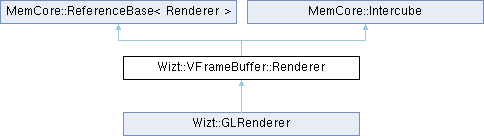
Classes | |
| struct | LayeredRenderResultWithError |
Public Member Functions | |
| virtual bool | canRender (const Size &Sz, format what=rgb, const type_info &type=typeid(unsigned char)) const |
| Check in advance if this renderer is able to provide an image of the specified quality. | |
| virtual LayeredRenderResultWithError | grab (const VRequest &Context, const RefPtr< Grab > &, const Size &Sz, const RefPtr< VFrameBuffer::Grab::MovieManager > &M, const RefPtr< VRenderPrecision > &RenderHints, const RefPtr< VContext::Addendum > &ContextAddendum=nullptr) const =0 |
| Virtual grab function that knows how to get the render objects. | |
| virtual LayeredRenderResultWithError | grab (const VRequest &Context, const VSceneLayers &RenderObjects, const RefPtr< Grab > &, const Size &Sz, const RefPtr< VFrameBuffer::Grab::MovieManager > &M, const RefPtr< VRenderPrecision > &RenderHints, const RefPtr< VContext::Addendum > &ContextAddendum=nullptr) const =0 |
| Virtual grab function, it is supposed to call Grab::retrieve();. | |
| bool | ProcessTile (VGrabContext &theContext, const RefPtr< Grab > &Grabber, const ImageTile &theImageTile, const RefPtr< VFrameBuffer::Grab::MovieManager > &) const |
| Call this function to deliver frame data to the Grab object after processing it with the local TileProcessor. | |
| Renderer (const WeakPtr< VRenderInterruptor > &theInterruptor) | |
| Constructor. | |
| int | Samples () const |
| Current antialiasing sample. | |
| virtual void | setCamera (const VCamera &TheCameraSettings) |
| An optionally implementable function that sets the camera parameters for the given shot. | |
| virtual bool | setupMultiSampling (int samples) |
| Setup samples for antialiasing default for virtual function is just assignment implementation in derived class would check for hardware capabilities. | |
| ~Renderer () | |
| Destructor. | |
| Public Member Functions inherited from MemCore::ReferenceBase< Renderer > | |
| auto | getObjectCountID () const noexcept |
| Get a unique ID for this object in the given domain. | |
| bool | isIdentical (const WeakPtr< Renderer, Renderer > &PossibleSelf) const noexcept |
| Check if this object is identical to the one used by the given pointer. | |
| void | mkAutoDestructive () |
| Marks this object as being automatically destructed, e.g. | |
| refcount_t | refcount () const noexcept |
| The strong reference count. | |
| ReferenceBase (Renderer *that) noexcept | |
| Constructor, initializes reference counter to zero. | |
| const auto & | self () const |
| Return weak pointer to the object self. | |
| refcount_t | wrefcount () const noexcept |
| The weak reference count. | |
| Public Member Functions inherited from MemCore::Intercube | |
| void | addInterface (const RefPtr< InterfaceBase > &I) const |
| Add an interface class object. | |
| template<class Data, typename TypeSelector> | |
| void | addInterfaceData (const Data &D) |
| Add data via an interface class object. | |
| template<class Data> | |
| void | addInterfaceData (const Data &D) |
| Add data via an interface class object. | |
| void | clearInterfaces () |
| Remove all interfaces. | |
| bool | const_iterateInterfaces (const RefPtr< InterfaceIterationParameter > &IIP) const |
| Constant iterator. | |
| virtual RefPtr< InterfaceBase > | createInterface (const type_info &) const |
| Virtual function which allows derived objects to create Interface objects on demand. | |
| RefPtr< InterfaceBase > | findInterface (const type_info &t) const |
| Find a certain interface of specified type. | |
| RefPtr< InterfaceBase > | getInterface (const type_info &t) |
| Retrieve an interface object from a certain type. | |
| std::string | getInterfaceNames (const char delim=';') const |
| Debug function retrieving all interfaces as human-readable string. | |
| template<class Data> | |
| bool | gotNewInterfaceData (const Data &D) |
| Check whether data on the given interface have changed, and if so, set new data as interface. | |
| template<class Data, typename Selector> | |
| bool | gotNewInterfaceData (mutex &M, const Data &D) |
| Check whether interface data have changed, if so, then set new interface data and return true. | |
| template<class Data> | |
| bool | gotNewInterfaceData (mutex &M, const Data &D) |
| Check whether interface data have changed, if so, then set new interface data and return true. | |
| template<class Data, typename Selector> | |
| bool | gotNewInterfaceData (mutex &M, const Data &D, const Selector &S) |
| Check whether interface data have changed, if so, then set new interface data and return true. | |
| template<class Data, typename Selector> | |
| bool | gotNewInterfaceData (mutex &M, const Data &D, const Selector *S) |
| Check whether interface data have changed, if so, then set new interface data and return true. | |
| template<class Data, typename Selector> | |
| bool | hasChangedInterfaceData (const Data &D) const |
| Check whether interface data have changed. | |
| template<class Data> | |
| bool | hasChangedInterfaceData (const Data &D) const |
| Check whether interface data have changed. | |
| template<class Data, typename Selector> | |
| bool | hasChangedInterfaceData (const Data &D, const Selector &) const |
| Check whether interface data have changed. | |
| template<class Data, typename Selector> | |
| bool | hasChangedInterfaceData (const Data &D, const Selector *) const |
| Check whether interface data have changed. | |
| bool | hasInterface (const type_info &t) const |
| Check if some Interface might exist. | |
| Intercube () | |
| Constructor. | |
| bool | iterateInterfaces (const RefPtr< InterfaceIterationParameter > &IIP) |
| Modifyable iterator. | |
| void | printInterfaces () const |
| Debug function that prints the names of all interfaces. | |
| void | registerInterface (const type_info &t) |
| Register an interface type; when the interface is actually required, the virtual createInterface() function will be called. | |
| template<class InterfaceType> | |
| void | removeInterface () |
| Remove an interface. | |
| void | removeInterfaceBase (const type_info &InterfaceBaseID) |
| Remove an interface. | |
| virtual | ~Intercube () |
| Destructor. | |
Additional Inherited Members | |
| Public Types inherited from MemCore::ReferenceBase< Renderer > | |
| using | reference_domain_t |
| The type of the base class. | |
| using | SelfPtr_t |
| Type for a pointer to this object itself. | |
| Protected Member Functions inherited from MemCore::ReferenceBase< Renderer > | |
| virtual void | extremeUnction () |
| A virtual function that will be called just before the object is destroyed. | |
| ReferenceBase & | operator= (const ReferenceBase &R) |
| Protected assignment operator (should not be called). | |
| void | suicide () |
| Delete this. | |
| virtual | ~ReferenceBase () |
| Virtual destructor. | |
Detailed Description
Base class for a renderer that is able to provide some pixel data.
an implementation may use OpenGL or any other method to do so.
Member Function Documentation
◆ grab() [1/2]
|
pure virtual |
Virtual grab function that knows how to get the render objects.
It is supposed to call Grab::retrieve();
- Parameters
-
Context The VRequest providing the context in which this function is called. It is used to avoid infinite recursions.
References grab().
◆ grab() [2/2]
|
pure virtual |
Virtual grab function, it is supposed to call Grab::retrieve();.
- Parameters
-
RenderObjects The objects that should be rendered here. Context The VRequest providing the context in which this function is called. It is used to avoid infinite recursions.
Referenced by grab().
◆ setCamera()
|
virtual |
An optionally implementable function that sets the camera parameters for the given shot.
This function is called after the grab() function, once all the rendering is done, because the camera settings may depend on the viewpoint settings that are determined during rendering.
It is the responsibility of the recording function to determine such camera parameters correctly and call this function. The implementation of a Grabber should not rely on this function to be called at all.
Generated on for The Vish Visualization Shell by
 1.16.1