Base class for OpenGL buffer objects, which are the building blocks of Vertex Buffer Objects. More...
#include <ocean/GLvish/BufferArray.hpp>
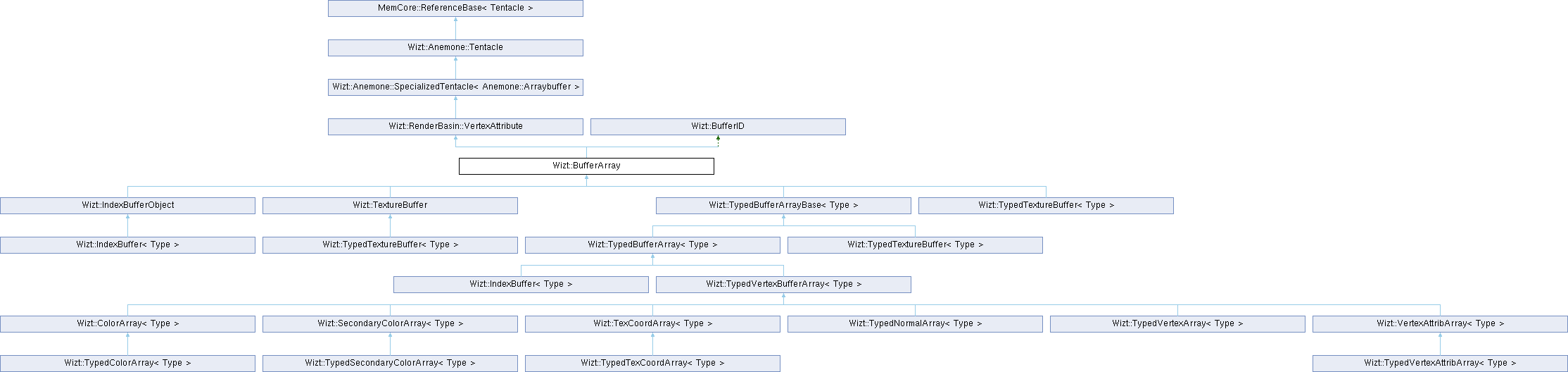
Classes | |
| struct | Error |
| Exception class that might happen during loading of buffer arrays. More... | |
| struct | Inconsistency |
| Exception class thrown when an array of incompatible number of elements is going to be added to a given VBO object. More... | |
| class | MapMemory |
| API For glMapBuffer. More... | |
Public Types | |
| enum | type |
| Possible types of buffer ID's. More... | |
| enum | usage |
| Specifies the expected usage pattern of the data store. More... | |
| Public Types inherited from MemCore::ReferenceBase< Tentacle > | |
| using | reference_domain_t |
| The type of the base class. | |
| using | SelfPtr_t |
| Type for a pointer to this object itself. | |
Public Member Functions | |
| BufferArray (type buffer_target, int AttributeClass=0) | |
| Construct an OpenGL buffer object (this call does NOT require an OpenGL Context). | |
| virtual size_t | getComponentSize () const =0 |
| Get size of a component in bytes. | |
| virtual size_t | getElementSize () const =0 |
| Return size of the type used for loading the data. | |
| GLuint | getId () const noexcept |
| Get an Id without attempting to generate it. | |
| GLsizei | getStride () const |
| A future version may use a stride that is shared among Buffers. | |
| bool | isIndexBuffer () const |
| Check whether this is an index buffer. | |
| bool | isVertexArray () const |
| Check whether this is a vertex array. | |
| template<class Type> | |
| bool | load_typed (const ::std::vector< Type > &data, size_t start, size_t end) |
| Load subset of data from a Standard Template Vector. | |
| template<class Type> | |
| bool | load_typed (const ::std::vector< Type > &data, usage usage_hint=STATIC_DRAW) |
| Load data from a Standard Template Vector. | |
| size_t | memsize () const |
| Return the memory occupied by this buffer. | |
| size_t | NumberOfElements () const |
| Returns the number of elements referenced via this BufferArray. | |
| GLuint | operator() () |
| On first access, OpenGL buffers will be generated. This function must be called from within a valid OpenGL context. | |
| ~BufferArray () | |
| Destructor - MUST be called within an OpenGL Context. | |
| Public Member Functions inherited from Wizt::Anemone::Tentacle | |
| virtual bool | activate (const Anemone &)=0 |
| Activate this tentacle. | |
| virtual bool | deactivate (const Anemone &)=0 |
| Deactivate this tentacle. | |
| virtual const char * | getSamplerType () const |
| If this tentacle refers to some texture sampler in a shader, then hereby return the type of this sampler is it occurs in the code. | |
| virtual int | getTextureUnit () const |
| Get the texture unit number which was specified during construction, if positive then it refers to some texture unit that is used in an associated shader. | |
| virtual bool | updateValue (VRenderContext &Context) |
| Possibly update a tentacle from settings in a context. | |
| Public Member Functions inherited from MemCore::ReferenceBase< Tentacle > | |
| auto | getObjectCountID () const noexcept |
| Get a unique ID for this object in the given domain. | |
| bool | isIdentical (const WeakPtr< Tentacle, Tentacle > &PossibleSelf) const noexcept |
| Check if this object is identical to the one used by the given pointer. | |
| void | mkAutoDestructive () |
| Marks this object as being automatically destructed, e.g. | |
| refcount_t | refcount () const noexcept |
| The strong reference count. | |
| ReferenceBase (Tentacle *that) noexcept | |
| Constructor, initializes reference counter to zero. | |
| const auto & | self () const |
| Return weak pointer to the object self. | |
| refcount_t | wrefcount () const noexcept |
| The weak reference count. | |
Protected Member Functions | |
| bool | load_subset (int offset, const void *ptr, memsize_t sz) const |
| Load a subset of the data on the graphics card, updating an existing buffer. | |
| bool | load_untyped (const void *ptr, memsize_t MemorySize, size_t nElements, usage usage_hint=STATIC_DRAW) |
| Loads the given data on the graphix card. | |
| Protected Member Functions inherited from MemCore::ReferenceBase< Tentacle > | |
| virtual void | extremeUnction () |
| A virtual function that will be called just before the object is destroyed. | |
| ReferenceBase & | operator= (const ReferenceBase &R) |
| Protected assignment operator (should not be called). | |
| void | suicide () |
| Delete this. | |
| virtual | ~ReferenceBase () |
| Virtual destructor. | |
| Protected Member Functions inherited from Wizt::BufferID | |
| bool | bindBuffer () const |
| const version of bind(), does not create a buffer ID. | |
| bool | bindBufferWithPossibleCreation () |
| Non-const version of bind(). | |
| BufferID (const type bufferType) noexcept | |
| The constructor does not yet create openGL buffers yet. | |
| GLuint | createId () noexcept |
| If no valid ID yet, call glCreateBuffers(). | |
| GLuint | getId () const noexcept |
| Get an Id without attempting to generate it. | |
| bool | isbound () const throw () |
| Verification function: buffer is bound? | |
| bool | isIndexBuffer () const |
| Check whether this is an index buffer. | |
| bool | isVertexArray () const |
| Check whether this is a vertex array. | |
| GLuint | makeId () |
| On first access, OpenGL buffers will be generated. This function must be called from within a valid OpenGL context. | |
| GLuint | operator() () |
| On first access, OpenGL buffers will be generated. This function must be called from within a valid OpenGL context. | |
| ~BufferID () noexcept | |
| Deletion of created OpenGL buffers. Note that this might be problematic here if called outside a valid OpenGL context. | |
Additional Inherited Members | |
| Public Attributes inherited from Wizt::RenderBasin::VertexAttribute | |
| unsigned | DoublePrecision:1 |
| Load data in double precision. | |
| unsigned | Integer:1 |
| Hint whether the attribute is an integer data type in the shader, in which case it will be loaded differently. | |
| unsigned | Normalized:1 |
| Indicate whether this buffer will be normalized to the range [0,1] if it is an integer type loaded to a floating point attribute. | |
| unsigned | Signed:1 |
| Indicate if this integer type is signed. | |
| Public Attributes inherited from Wizt::Anemone::Tentacle | |
| Activity_t | Activity |
| A bit mask telling whether this tentacle should participate in the waving of an Anemone. | |
| Protected Types inherited from Wizt::BufferID | |
| enum | type |
| Possible types of buffer ID's. More... | |
| Protected Attributes inherited from Wizt::BufferID | |
| const type | target |
| The target type of this buffer ID. | |
Detailed Description
Base class for OpenGL buffer objects, which are the building blocks of Vertex Buffer Objects.
A possible exception-save usage scenario is via the activateVB() macro:
Member Enumeration Documentation
◆ type
| enum Wizt::BufferID::type |
Possible types of buffer ID's.
◆ usage
Specifies the expected usage pattern of the data store.
- STREAM The data store contents will be modified once and used at most a few times.
- STATIC The data store contents will be modified once and used many times.
- DYNAMIC The data store contents will be modified repeatedly and used many times.
The nature of access may be one of these:
- DRAW The data store contents are modified by the application, and used as the source for GL drawing and image specification commands.
- READ The data store contents are modified by reading data from the GL, and used to return that data when queried by the application.
- COPY The data store contents are modified by reading data from the GL, and used as the source for GL drawing and image specification commands.
Constructor & Destructor Documentation
◆ ~BufferArray()
| Wizt::BufferArray::~BufferArray | ( | ) |
Destructor - MUST be called within an OpenGL Context.
If called in an non-OpenGL context, segmentation faults in the OpenGL driver/library will most likely occur. The preferred way is to store BufferArray objects in a GLCache, but NOT in an user-defined structure. The GLCache is supposed to be destroyed by the application when the OpenGL Context is destroyed, which is NOT when the containing objects are destroyed. Rather it is when a windows is closed, but not yet the application.
This mechanism does require special care and is non-trivial.
References Wizt::GLContextChecker::invalidContext().
Member Function Documentation
◆ getId()
|
noexcept |
Get an Id without attempting to generate it.
This function is safe to be called from a non-OpenGL context.
References Wizt::BufferID::target.
Referenced by Wizt::TextureBuffer::activate().
◆ load_subset()
|
protected |
Load a subset of the data on the graphics card, updating an existing buffer.
Calls glBufferSubData() . http://www.opengl.org/sdk/docs/man/xhtml/glBufferSubData.xml
When replacing the entire data store, consider using glBufferSubData rather than completely recreating the data store with glBufferData. This avoids the cost of reallocating the data store.
Consider using multiple buffer objects to avoid stalling the rendering pipeline during data store updates. If any rendering in the pipeline makes reference to data in the buffer object being updated by glBufferSubData, especially from the specific region being updated, that rendering must drain from the pipeline before the data store can be updated.
Clients must align data elements consistent with the requirements of the client platform, with an additional base-level requirement that an offset within a buffer to a datum comprising N bytes be a multiple of N.
References Wizt::BufferID::bindBuffer(), and Wizt::BufferID::target.
Referenced by load_typed().
◆ load_untyped()
|
protected |
Loads the given data on the graphix card.
Binds the current target and calls glBufferData().
- Parameters
-
MemorySize How much memory will this call occupy on the GPU? This value will be used in conjunction with the GLCache. nElements How much elements will be used in this array? This value will be used to check the consistency of Vertex Buffer Arrays, if an array with different number of elements is added, then an Inconsistency exception will be thrown.
- Note
- Clients must align data elements consistent with the requirements of the client platform, with an additional base-level requirement that an offset within a buffer to a datum comprising N bytes be a multiple of N.
- Todo
- Call does unbind() internally. Think if that is a problem and/or should be optimized.
References Wizt::BufferID::bindBuffer(), Wizt::BufferID::createId(), load_untyped(), Wizt::BufferID::makeId(), MemCore::Timer::secs(), and Wizt::BufferID::target.
Referenced by load_typed(), and load_untyped().
◆ NumberOfElements()
|
inlinevirtual |
Returns the number of elements referenced via this BufferArray.
It will be zero at construction and only be set using a \i typed load() call.
Reimplemented from Wizt::Anemone::Tentacle.
Referenced by Wizt::TextureBuffer::activate().
Generated on for The Vish Visualization Shell by
 1.16.1