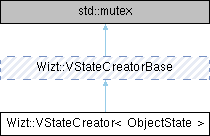
This is an experimental class to easy creation of context-relative object states. More...
#include <ocean/plankton/VObjectState.hpp>
Classes | |
| struct | MyState |
Public Member Functions | |
| RefPtr< VStateCreatorBase::State > | newState () const override |
| Implementation of the virtual object state creation function. | |
| Public Member Functions inherited from Wizt::VStateCreatorBase | |
| RefPtr< State > & | getState (const WeakPtr< ValuePool > &VP) const |
| Retrieve a pointer to a state object for the given context. | |
| RefPtr< InterfaceBase > | hasLocalInterface (const type_info &InterfaceType) const |
| Check whether any of the local object states has an interface of the given type. | |
| RefPtr< State > | myState (const WeakPtr< ValuePool > &Context) const |
| Retrieve a state for the current context, possibly creating one. | |
| void | setState (const WeakPtr< ValuePool > &, const RefPtr< State > &st) const |
| Set a state object for a given context. | |
Detailed Description
struct Wizt::VStateCreator< ObjectState >
This is an experimental class to easy creation of context-relative object states.
The template parameter is a class providing local variables. Deriving from this class reliefs the child class from implementing the virtual newState() function. It is sufficient to derive a Vish object (virtually) from a VStateCreator<UserState> where UserState is a user-defined structure. It will be dynamically create by the newState() function.
Using this mechanism, the local state class must be defined before the derived Vish object is defined; the local state class cannot be a nested class. However, such classes may reside in an anonymous namespace if the Vish object is defined only within a .cpp file as well.
A problem with this class may occur when an a class hierarchy defines different local states, then it becomes unclear which implementation will be used for creating a state.
Generated on for The Vish Visualization Shell by
 1.16.1