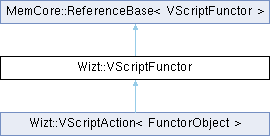
Implementation of a function that may be called through a script interface. More...
#include <ocean/plankton/VScript.hpp>
Public Member Functions | |
| virtual RefPtr< VScriptValue > | call (const RefPtr< VScriptParameters > &V, const RefPtr< ValuePool > &VP)=0 |
| Call a functor relative to a Context. | |
| virtual RefPtr< VScriptParameters > | describe () const =0 |
| Retrieve parameter description of a functor. | |
| Public Member Functions inherited from MemCore::ReferenceBase< VScriptFunctor > | |
| auto | getObjectCountID () const noexcept |
| Get a unique ID for this object in the given domain. | |
| bool | isIdentical (const WeakPtr< VScriptFunctor, VScriptFunctor > &PossibleSelf) const noexcept |
| Check if this object is identical to the one used by the given pointer. | |
| void | mkAutoDestructive () |
| Marks this object as being automatically destructed, e.g. | |
| refcount_t | refcount () const noexcept |
| The strong reference count. | |
| ReferenceBase (VScriptFunctor *that) noexcept | |
| Constructor, initializes reference counter to zero. | |
| const auto & | self () const |
| Return weak pointer to the object self. | |
| refcount_t | wrefcount () const noexcept |
| The weak reference count. | |
Additional Inherited Members | |
| Public Types inherited from MemCore::ReferenceBase< VScriptFunctor > | |
| using | reference_domain_t |
| The type of the base class. | |
| using | SelfPtr_t |
| Type for a pointer to this object itself. | |
| Protected Member Functions inherited from MemCore::ReferenceBase< VScriptFunctor > | |
| virtual void | extremeUnction () |
| A virtual function that will be called just before the object is destroyed. | |
| ReferenceBase & | operator= (const ReferenceBase &R) |
| Protected assignment operator (should not be called). | |
| void | suicide () |
| Delete this. | |
| virtual | ~ReferenceBase () |
| Virtual destructor. | |
Detailed Description
Implementation of a function that may be called through a script interface.
The function is invoked via the call() member function. The functor also allows to retrieve information about how to call the function via the member function describe() which returns the desired parameter list.
A function may be polymorphic and behave differently depending on the provided argument types. Each argument comes with a list of possible types in the argument description. Upon function call, only one type is set.
Each argument is specified via a name. Instead of providing this full name, also aliases and shortcuts can be specified.
The return value of the function may be of different type, depending on the function's behaviour.
In any case all values are transported in the form of textual encodings within a string.
Generated on for The Vish Visualization Shell by
 1.16.1