Wizt::VScalarFunctor::Functor Struct Referenceabstract
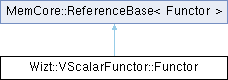
Inheritance diagram for Wizt::VScalarFunctor::Functor:
Public Member Functions | |
| virtual string | Expression (const string &funcname) const =0 |
| Return a string describing the actual operation on scalar values. | |
| Public Member Functions inherited from MemCore::ReferenceBase< Functor > | |
| auto | getObjectCountID () const noexcept |
| Get a unique ID for this object in the given domain. | |
| bool | isIdentical (const WeakPtr< Functor, Functor > &PossibleSelf) const noexcept |
| Check if this object is identical to the one used by the given pointer. | |
| void | mkAutoDestructive () |
| Marks this object as being automatically destructed, e.g. | |
| refcount_t | refcount () const noexcept |
| The strong reference count. | |
| ReferenceBase (Functor *that) noexcept | |
| Constructor, initializes reference counter to zero. | |
| const auto & | self () const |
| Return weak pointer to the object self. | |
| refcount_t | wrefcount () const noexcept |
| The weak reference count. | |
Additional Inherited Members | |
| Public Types inherited from MemCore::ReferenceBase< Functor > | |
| using | reference_domain_t |
| The type of the base class. | |
| using | SelfPtr_t |
| Type for a pointer to this object itself. | |
| Protected Member Functions inherited from MemCore::ReferenceBase< Functor > | |
| virtual void | extremeUnction () |
| A virtual function that will be called just before the object is destroyed. | |
| ReferenceBase & | operator= (const ReferenceBase &R) |
| Protected assignment operator (should not be called). | |
| void | suicide () |
| Delete this. | |
| virtual | ~ReferenceBase () |
| Virtual destructor. | |
Member Function Documentation
◆ Expression()
|
pure virtual |
Return a string describing the actual operation on scalar values.
It must conform to a function definition as required by OpenGL shader language, i.e. in GSGL format. For instance:
float f(float value) { return value*100; }
whereby the name of the function is as given by the parameter.
Generated on for The Vish Visualization Shell by
 1.16.1