Base class for pointers to base classes. More...
#include <elementary/memcore/DynPtr.hpp>
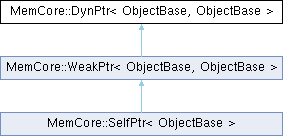
Public Types | |
| template<typename Object> | |
| using | DerivedDynPtr = DynPtr<Object, ObjectBase> |
| Template member referring to derived DynPtrs. | |
| typedef DynPtr< ObjectBase, ObjectBase > | DynPtr_t |
| Base class pointer. | |
| typedef ObjectBase | object_t |
| Type of the associated object. | |
| using | ObjectBase_t = ObjectBase |
| Base class from which pointer hierarchy starts. | |
Public Member Functions | |
| void | deleteReferer () |
| Explicitely delete the intermediate referer and invalidate the internal pointer. | |
| DynPtr (const DynPtr &D) | |
| Copy constructor. | |
| DynPtr (const std::nullptr_t &) | |
| Construct from NullPtr. | |
| DynPtr (ObjectBase *Obj, const NotNullPtr &) | |
| Non=null constructor. | |
| DynPtr (ObjectBase *Obj, const SelfInitialize &) | |
| Internal constructor. | |
| DynPtr (Referer_t *SomeReferer) | |
| Construct from referer object. | |
| bool | expired () const noexcept |
| check whether the current pointer is valid | |
| bool | force_destroy () const |
| Delete the associated object unconditionally and mark this pointer as invalid. | |
| const auto & | getPointerID () const |
| To be used as substitute for the address in memory as this one provides a more deterministic value to enhance reproducibility. | |
| const type_info & | getType () const noexcept |
| Return type info of associated object,. | |
| bool | isAssignable (const DynPtr< ObjectBase, ObjectBase > &Other) const noexcept |
| Check whether a given pointer to a base class may be assigned to a pointer of the derived class. | |
| DynPtr & | operator= (const DynPtr &P) noexcept |
| Assignment operator, just copies the Referer pointer. | |
| ObjectBase * | rawptr () const |
| return pointer to referenced object, if valid pointer, otherwise NULL. | |
| void | ref () const |
| Increment the reference count. | |
| void | unref () const |
| Decrement the reference count. | |
| bool | valid () const noexcept |
| check whether the current pointer is valid | |
| void | wref () const noexcept |
| increment the weak reference count | |
| void | wunref () noexcept |
| Decrement the weak reference count and remove the referer if it reaches zero. | |
| ~DynPtr () | |
| Destructor of the dynamic pointer. | |
Validity Operators | |
| operator void * () const noexcept | |
| Check if the pointer is valid. | |
| bool | operator! () const noexcept |
| Check if the pointer is null. | |
Analyse functions for debugging | |
| refcount_t | strong_refs () const noexcept |
| Return the strong reference count, ie. | |
| refcount_t | weak_refs () const noexcept |
| Return the weak reference count, ie. | |
Pointer arithmetic | |
| size_t | hash_value () const noexcept |
| Return an integer value which is suitable for hashing. | |
| const void * | value () const noexcept |
| Return an void* value for debug output. Must not be used otherwise! | |
| std::string | addrstr () const noexcept |
| make a string containing hex numbers from the object's adress. | |
| std::string | to_string () const |
| Convert information about this pointer to a human-readable form. | |
| void | speak (const char *s, const char *prefix="") const noexcept |
| Print some debug messages to the console via printf(). | |
| void | Speak (const char *s, const char *prefix="") const |
| Print some debug messages to the console via printf(); this is a higher-level version of speak() which demangles the type names. | |
| bool | operator!= (const std::nullptr_t &) const noexcept |
| inequality operator | |
| bool | operator!= (const DynPtr &other) const noexcept |
| inequality operator | |
| bool | operator== (const DynPtr &other) const noexcept |
| Equality operator. | |
| bool | operator< (const DynPtr &other) const noexcept |
| lesser than operator | |
| bool | operator<= (const DynPtr &other) const noexcept |
| lesser equal than operator | |
| bool | operator> (const DynPtr &other) const noexcept |
| greater than operator | |
| bool | operator>= (const DynPtr &other) const noexcept |
| greater than operator | |
Public Attributes | |
| Memcore_DynPtr_pointer_ID_class_access | : PointerID_t myPointerID = -1 |
| The intermediate referer object for indirect referencing. | |
Protected Member Functions | |
| void | assignReferer (const DynPtr &P) noexcept |
| Assignment, copies the Referer pointer, used within derived classes. | |
Detailed Description
class MemCore::DynPtr< ObjectBase, ObjectBase >
Base class for pointers to base classes.
Implements basic operations on pointers.
Constructor & Destructor Documentation
◆ ~DynPtr()
|
inline |
Destructor of the dynamic pointer.
It does neither touch the reference counting nor eventually delete the associated object, although it can detect a possible memory leak.
Note that even if the strong reference count is zero, the object is not destroyed.
        Data*Dptr = new Data(10);
        {
                WeakPtrImpl<Data> d = Dptr;
        }
        delete Dptr;
Member Function Documentation
◆ getType()
|
inlinenoexcept |
Return type info of associated object,.
- typeid(void) is returned if the pointer is NULL
◆ isAssignable()
|
inlinenoexcept |
Check whether a given pointer to a base class may be assigned to a pointer of the derived class.
This function doesn't need to create a new pointer and is thus little lighter than pointer assignment, it basically just involves a dynamic_cast.
◆ operator==()
|
inlinenoexcept |
Equality operator.
It compares the adresses of the intermediate reference object, not of the true data object. This enables comparisions with actually deleted objects when the WeakPtrImpl already is invalid: Two invalid WeakPtrImpl<>'s are ONLY equal if they both referred to the same deleted object, otherwise they are UNEQUAL, even if both are invalid and compare true to a NullPtr() !
◆ ref()
|
inline |
Increment the reference count.
Note that only semi-positive refcounts are increased. A negative refcount indicates a static or automatic object, i.e. one which does not require any refcounting at all.
- Note
- The first referencing to a strong pointer will call deferred_initialize() . This function might possibly throw an exception.
◆ strong_refs()
|
inlinenoexcept |
Return the strong reference count, ie.
how many pointers keep the object alive. Note that an negative value indicates a dead object. If the returned value is null_referencer , then there is not even a referer object, ie. no more weak references exist. Actually, this cannot happen and indicates a bug, like intermediate usage of native pointers. Only somewhere in intermediate constuctor code such things are thinkable.
References MemCore::ReferenceCount::null_referencer.
◆ unref()
|
inline |
Decrement the reference count.
Once it reaches zero value, the object is inevitably destroyed and the reference count is set to -1 to indicate invalidity. There is no way to reset the reference count from a negative value to a positive one. Any further ref() calls will be ignored, the object is lost forever, but its referer object may still be alive as a zombie placeholder.
References MemCore::PreDestructionTrait< Object >::predestruct(), and valid().
Referenced by force_destroy().
◆ weak_refs()
|
inlinenoexcept |
Return the weak reference count, ie.
how many references exist to the object. Note that if only weak references exist to an object, it is likely to be a zombie.
References MemCore::ReferenceCount::null_referencer.
Referenced by to_string().
Generated on for The Vish Visualization Shell by
 1.16.1